Showing posts with label LDC for NDC. Show all posts

Thursday, November 10, 2022

Musings from Priyadarshini Karve: #COP27: Day 3

 #COP27: Day 3


9 November 2022 was officially 'Finance Day'. The negotiators discussed finance for mitigation, adaptation and also for 'loss and damage'. The side events of the day were also focused on the theme of finance. 

As we entered the venue we came across an interesting protest displaying a dinosaur and a Pokémon! A number of young activists were speaking on how climate change induced disasters are affecting their countries. The demand of this protest was 'Stop Funding Fossil Fuels'. 

Stop Funding Fossil Fuels! 

I attended two side events - both organised by members of Climate Action Network (CAN) and focused on 'Adaptation' and 'Loss and Damage'. 

I am going to digress a bit and try to explain these terms. 

When it comes to climate action, the media and public discourse is generally focused on 'Mitigation' - reducing greenhouse gas emissions going into the atmosphere. This is important for slowing down future warming of planet earth. This requires moving away from fossil fuel use and change our land use pattern. Most of the climate finance is currently focused on this aspect. 

However there is also 'Adaptation'. The planet is already about 1.1 deg C warmer than the preindustrial era. This has changed the weather patterns and ecosystems around the world permanently. People now have to change their ways and means of life in order to deal with the changes. Some of the challenges may be solved by behavioural change (for example - change the timing of outdoor work to deal with excessively hot summers) but some require use of technology (for example - rainwater harvesting and storage for better water security in spite of the erratic rainfall). Financing for adaptation has been a contentious issue at COPs for a long time. Developed countries have promised big money but actually provided very little. 

A third front on climate action now is 'Loss and Damage'. As global average temperature has creeped up over the last few decades, many communities across the globe are facing an existential crisis (for example - the Maldives will be totally submerged in a decade or so even if all GHG emissions drop to zero today). As sea levels rise, coastal communities lose their lands and homes and therefore their way of life, culture and traditions. They are getting uprooted and displaced. As certain parts of the world are repeatedly hit by cyclones, people are losing lives and livelihoods. For a long time, the developed countries have tried to argue that dealing with such situations also should be considered 'Adaptation' (and therefore no separate funding is needed for this). But the developing countries have strongly argued that 'Loss and Damage' is happening because both 'Mitigation' and 'Adaptation' are failing. Some countries need urgent help while we strengthen the efforts on Mitigation and Adaptation. Finally, this year financing for 'Loss and Damage' is being discussed. The news is that the countries have agreed to put in place a mechanism for this 'no later than 2024'. 

The first side event in the morning was by CANSA (CAN South Asia) of which INECC is a member. There were presentations from Nepal and Bangladesh talking about how localised and community-centric action with co-operation and collaboration of government is helping these two highly affected countries adapt better and thereby minimise loss and damage. This exactly resonated with our own 'LDC for NDC' concept. Both the presentations also strongly highlighted the importance of the support of government machinery from local to national for more effective adaptation at the local level. 

The final speaker of the event was a Minister from Pakistan. Pakistan is proving to be the showcase of 'Loss and Damage' in this COP. As the minister said - the country suffered an extremely hot summer followed by unprecedented and devastating floods during the monsoon season, and now it is entering what is likely to be an extremely cold winter! Climate change is really hammering them hard from all sides! It is no wonder therefore that the Pakistan pavilion has a caption 'Lost and Damaged' prominently on display. 

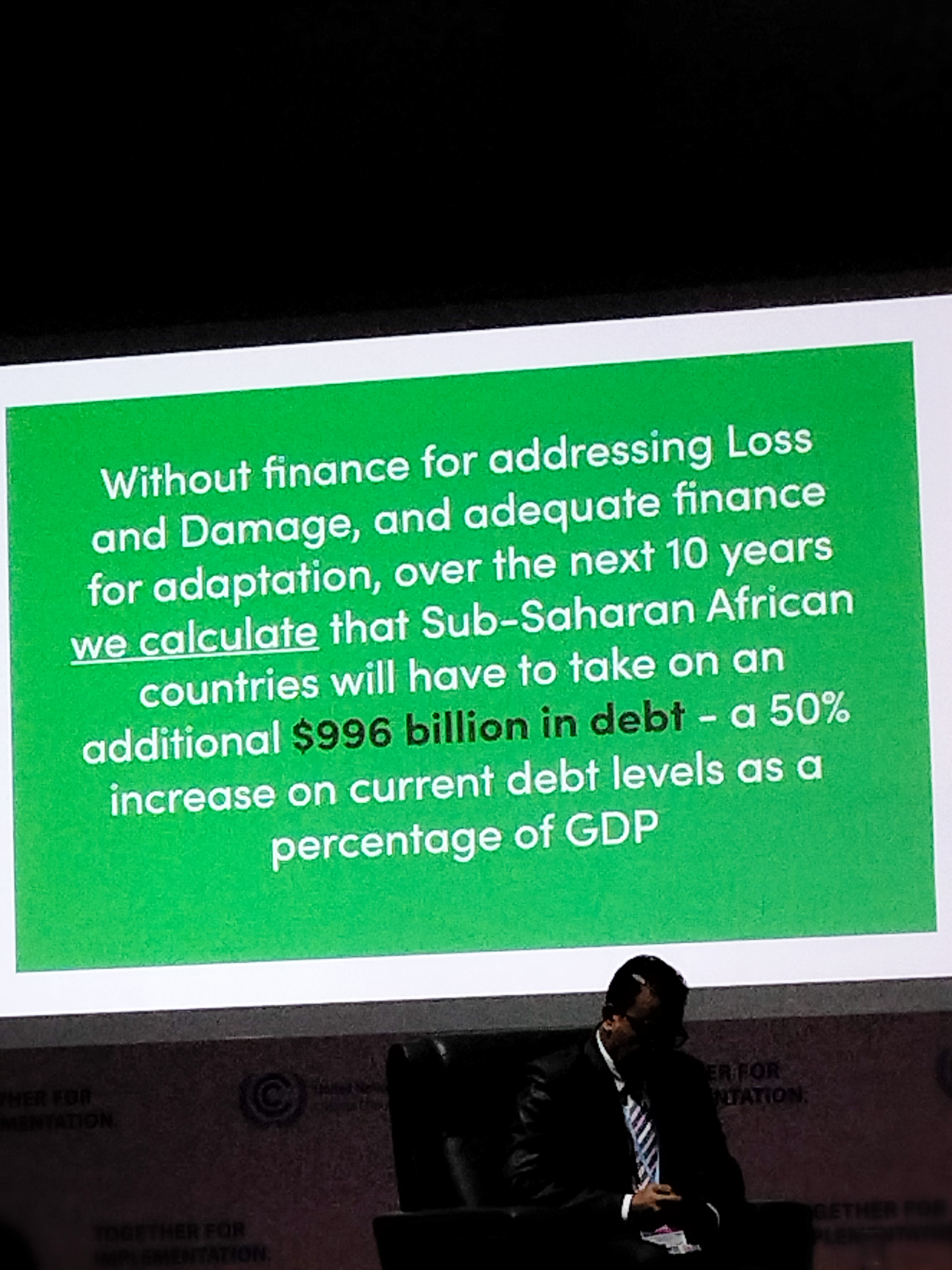
One important point that was made in this side event was around the nature of finance. Even though it is a moral obligation of the developed world to help the developing world deal with climate change, 70% of the climate finance available (of all categories) is in the form of debt and that too at very high interest rates! Strong arguments are therefore being made on all fronts that existing debts be written off and future finance not have a 'debt' component. One slide that presented eye opening statistics in this context is what you can see below. 
The Climate Debt Trap

The second side event was organised by CAN and a few collaborators. Its focus was 'Loss and Damage'. It had presentations from Malawi in Africa and Bangladesh. There were also presentations about how women are more affected than men when it comes to loss and damage. All in all there were very moving presentations starkly highlighting the plight of the vulnerable communities. One important point made was that while a lot of funding pours in for disaster relief when a tragedy strikes, not much finance is available for preventive or preparatory measures. It is hoped that the 'Loss and Damage' funding will address this gap. 

As my colleague Pournima pointed out - often in the discussion on loss and damage, the communities come across as helpless and clueless people doing nothing as disasters creep on them. But the ground reality is that communities can exhibit resilience and resourcefulness. They are not totally without any agency of their own! They of course need a helping hand - in the form of finance as well as in the form of knowledge and data. 

The loss and damage finance facility needs to focus on empowering communities to protect and rescue themselves in a sustainable way. Our 'LDC for NDC' process is showcasing some of the success stories of this approach. 


Day 2 Blog

Day 1 Blog


Priyadarshini Karve
Director, Samuchit Enviro Tech
Convener, Indian Network on Ethics and Climate Change (INECC)

Wednesday, November 9, 2022

Musings from Priyadarshini Karve: #COP27: Day 2

 #COP27: Day 2

8 November 2022, the second day of COP27, was an important day for our team. We were going to kick off the calendar of side events! 

While the UNFCCC COP is primarily about various government representatives negotiating the future of state-lead climate action across the world, the observer organisations attending the conference have their own calendar of events. In this COP we have been assigned a booth for 3 days and we were also allotted a slot for a side event. We had applied for a side event a few months ago, but we were waitlisted (many organisations are keen to have their say on the global platform, however there are space and time constraints). We were finally sanctioned a side event after we agreed to merge with another organisation. This happens a lot of the times and generally the collaborators try to present a single cohesive side event of 1.5 hr duration. Sometimes it does not work out that way - which was our case this time. 

We thus had 45 min to say our piece. As the moderator of the session I am happy to say that everything worked smoothly, the speakers stayed on schedule, and we managed to hand over the stage to the next moderator on the 44th minute. I feel rather proud of our team work and planning that made this work in an effortless manner. 

Laya Side Event COP27: 
From L to R: Nakul Sharma, Martin Voss, Myron Mendes, Priyadarshini Karve

So what was our side event about? 

We talked on 'Locally Developed Choices' for 'Nationally Determined Contributions' - LDC for NDC. This is INECC's current theme of action and we wanted to talk about it with the global audience. The gist of our argument is this: 

Paris Agreement is not just about keeping the warming below 1.5 deg C, it also talks about helping the climate-affected populations for adaptation. However, this aspect has always been ignored by the UN negotiators. This year finally the COP is looking at 'Loss and Damage' (more about this in a latter blog!) but the developing countries really had to struggle hard to get the topic on the discussion agenda. If one looks at the NDCs (commitments by individual national governments under Paris Agreement) these too only talk about mitigation. As a result, when climate change impacts hit locally, communities have to fend for themselves. This is however leading to some innovative choices being developed locally (LDC) that can not only achieve adaptation but also contribute to mitigation. For the last couple of years INECC has been trying to document such LDC and trying to build an awareness raising as well as policy advocacy campaign around these initiatives. 

Laya Side Event @ COP27:
Priyadarshini explaining '
LDC for NDC'
In the side event I explained the 'LDC for NDC' concept with the example of lacunae in India's NDC and also briefly described the work we have done so far on this theme. My colleague Myron Mendes presented the case study of Laya's work on resilience building among the indigenous communities in the Eastern Ghats through technology interventions in agriculture and basic services. Nakul Sharma of Climate Action Network South Asia (CANSA) presented a case study of local action for adaptation from Nepal which described a wonderful collaboration between local community groups and local government. The final speaker was Martin Voss of GermanWatch who talked about how the big multilateral banks can and should fund replication of such success stories... but unfortunately are still stuck in the conventional thinking of pouring money into big infrastructure projects. 

Even though we had 4 speakers and only 45 minutes, we had structured the session in such a way as to keep 10 minutes for questions and comments from the floor. And this turned out to be a very good decision! We had an audience of about 20-30 people. A member of the organisation leading the local action in Nepal was present in the audience and gave some additional detail on the case study presented by Nakul. The theme of LDC for NDC seemed to have really resonated with people from Africa in the audience. A couple of them made very moving comments on personal experiences of how the local reality is being ignored by the state-driven 'climate action'. One audience member pointed out the importance of understanding local vulnerabilities to shape adaptation - basically that funding for adaptation and resilience building must be targeted at ecosystem community level rather than at country level.  

All in all, I can say that we managed to get our point across. We felt highly encouraged by the reactions from the audience and hope to build an international momentum behind LDC for NDC! 

The side event was livestreamed and for those who are interested here is the link. We are in the first 45 min.  


Day 1 Blog


Priyadarshini Karve
Director, Samuchit Enviro Tech
Convener, Indian Network on Ethics and Climate Change (INECC)

Tuesday, November 8, 2022

Musings from Priyadarshini Karve: #COP27: Day 1

 #COP27: Day 1

UNFCCC's annual conference of parties (COP) is held every year during November. While the main work of negotiating for global climate action goes on through diplomatic and ministerial meetings the Observer Organisations (mainly civil society and academic organisations as well as religious faith groups) have the opportunity to connect with like minded people across the world. 

I am here at Sherm Al Sheikh in Egypt for the 27th edition of the COP and as a part of a delegation from 'Laya' the secretariat of Indian Network on Ethics and Climate Change (INECC). 

On Day 1 - 7 Nov 2022 - we primarily set up the exhibition booth which has been allotted to us for 3 days. In the photograph you see us at our stall. 

From L to R: Durgesh of SayTrees, Pournima of Laya, INECC & Samuchit, Priyadarshini of INECC & Samuchit, Myron of INECC & Laya

A little bit of walking around the exhibition booths and various pavilions and soaking up the overall atmosphere and vibe is all I have done on Day 1. 

It is always interesting to visit the various country pavilions. Typically, they follow two approaches. One approach is to create a lot of open space for people to sit and talk and listen to various events happening within the country pavilion. There is some information about the country's climate action but presented subtly through posters etc. Most of the developed country pavilions are in this format. The other approach is to flamboyantly display the past and present of the country and create a welcoming vibe to tempt people to drop in and have a chat. Some also offer souvenirs from the country. This is the format followed by the developing countries generally.  

India pavilion however does neither which is perhaps appropriate as we are always in this identity crisis of whether we are developed or developing! The pavilion is a very officious and high-tech display of central government schemes contributing to climate action. There are slogans everywhere about how India's climate action is 'people-centric' but there are hardly any 'people' in the overall display. There is a closed seating area at the back for interactions being held within the pavilion. It is a tiny space with just about 20 chairs... Not expecting a lot of audience for events in the pavilion perhaps? 

A view of the India Pavilion at COP27

We have an official side event coming up on Day 2. Based on the calendar put out by UNFCC this will be the first side event of this COP and we have been assigned a 150-seater room for this. If you have any friends or colleagues at COP27 please ask them to drop by! The event is open to all registered delegates. 

Laya - INECC Side Event Invitation

Priyadarshini Karve
Director, Samuchit Enviro Tech
Convener, Indian Network on Ethics and Climate Change (INECC)