Showing posts with label UNFCCC. Show all posts

Monday, November 14, 2022

Musings from Priyadarshini Karve: #COP27: Day 6

 #COP27: Day 6

Saturday November 12 was our last day at COP27. The meeting also takes a break on Sunday and will continue for another week. But our stay here is over. 

As I mentioned in one of the previous blogs, Egypt and Sherm al Sheikh have not done a great job with the logistics of the conference. 

It was not clear till about two weeks before the start of the conference whether we would even be able to be here. The hotels all over the city were arbitrarily hiking prices and refusing to confirm reservations. We managed to sort out our stay arrangements and were able to absorb the escalated cost, but many other people from NGO sector had to cancel their trips. Several people were blackmailed into paying more after arrival here. 

For almost half of the first week the prices of food and beverages inside the venue of the conference were exhorbitantly high. After a lot of protest from the observer organisations the food prices were slashed by half. It seems that the hotels with bookings for the second week of the conference have also been told to lower their prices and not demand extra money from the participants. But all in all, it appeared that the hosts tried their best to contain the civil society presence at the COP. However, those of us who did get here and those who will come in the second week in spite of all the hurdles have certainly made our presence felt. There has been some protest or other going on almost daily and drawing a lot of media attention from around the world. 

Some of the newslinks are here and here and here.
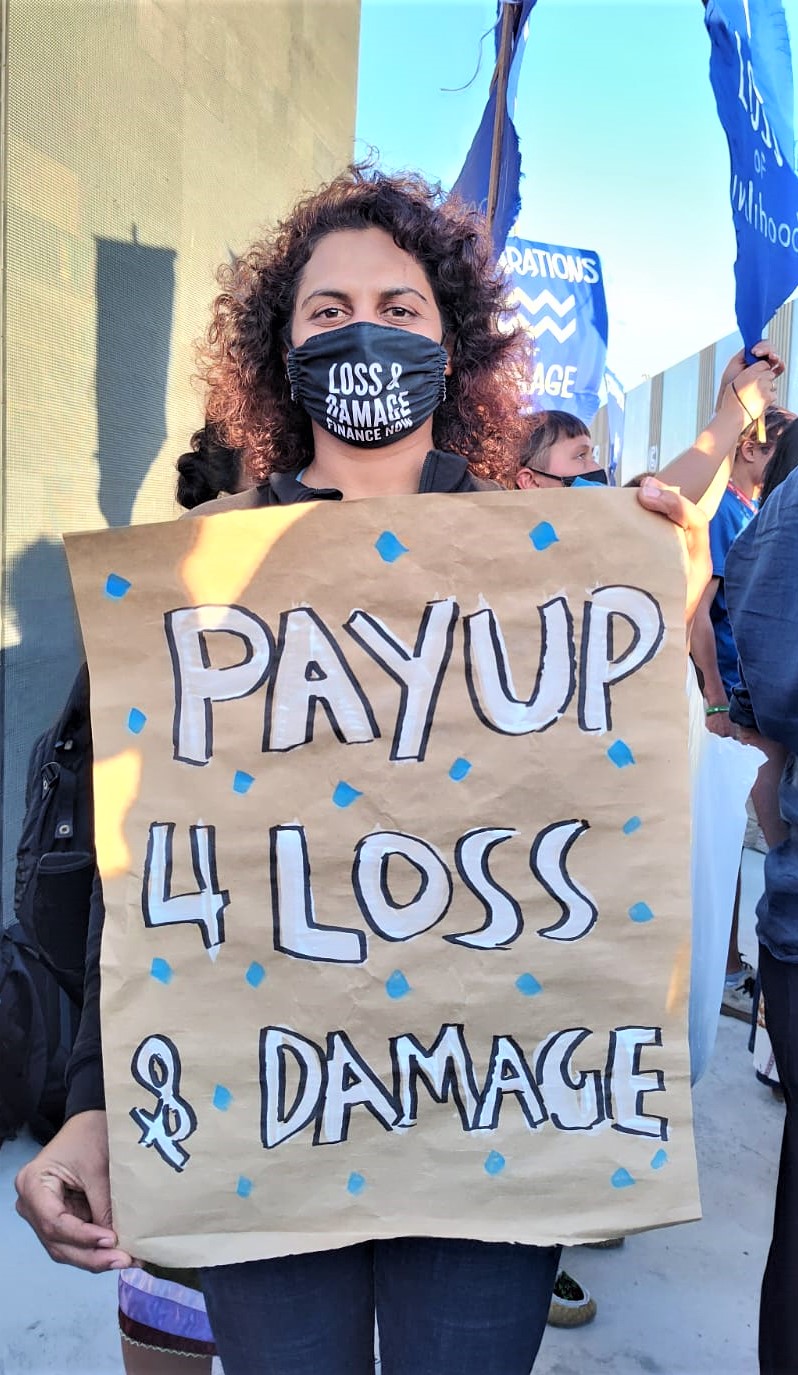
INECC team member Pournima in the Climate Action Network (CAN) Protest

On my last day at COP27, I attended what was for me the best side event. It was organised by International Network for Sustainable Energy (INFORSE) and had speakers from Europe, Africa and South Asia. It was interesting to see that organisations in Denmark on one hand and several prominent countries in Africa on the other hand have come up with systematic plans to shift to 100% renewable energy with a clear timeline. The plans presented were very much grounded in practicality and focused on solar - wind - hydro and sustainable biomass energy with each country focusing on its own unique combination. The south Asian presenters were from India, Bangladesh, Nepal and Sri Lanka. They too presented how localised renewable energy solutions that are helping local communities to achieve climate adaptation as well as contribute to mitigation. This was exactly the pathway that we too are pushing for through our #LDCforNDC campaign. 

Personally, it was heartening to see that in spite of the big push and bad mouthing of biomass fuelled cooking by LPG and electricity lobby, the grassroots level organisations in Africa and South Asia still see the importance of improved cook stoves and biogas plants based on waste biomass as the more realistic solutions for meeting cooking energy needs. They also had practical data on how these humble interventions support both adaptation and mitigation. 

What I liked the most about this side event was that all the presentations were to the point, matter-of-fact showcasing of solutions without dwelling much on 'victim' status of the communities. 

Another observation that was personally important to me - I saw on the stage several individuals and organisations that I had connected with at some point or other in the last 22 years of my professional career! I was really happy to see that all of us are still continuing to fight the 'good fight' in our own spheres of influence! I will surely be re-connecting with all of them in the near future and will explore what more we can do collectively. 

On this positive note I am now ending this series of blogs from COP27. Thank you all of those who read and encouraged me to keep this going! 

Climate Action must go hand in hand with SDGs to achieve climate justice

Day 5 Blog

Day 4 Blog

Day 3 Blog

Day 2 Blog

Day 1 Blog


Priyadarshini Karve
Director, Samuchit Enviro Tech
Convener, Indian Network on Ethics and Climate Change (INECC)

Saturday, November 12, 2022

Musings from Priyadarshini Karve: #COP27: Day 5

 #COP27: Day 5

11 November was the BIG high security day with the US President Joe Biden coming to the COP stage. Given USA's track record with the UNFCCC process, the US presence at COPs should be protested as much as the presence of fossil fuel industry at COP is protested! But unfortunately, politics trumps ethical considerations in this case. 

If the Kyoto agreement had actually been delivered by the developed world, we would not be in the mess that we are currently in. The most important factor that weakened the Kyoto agreement was USA, the biggest emitter of greenhouse gases, walking out of the treaty. 

The successor to Kyoto agreement was to be structured by 2010 and should have been ready to be implemented by 2015 if not 2012 (the end date for Kyoto agreement). This process was stalled by President Obama. This delayed the formulation of Paris agreement to 2015 and then its implementation to 2022 - nearly 10 years delay during which the earth continued to heat up. 

In 2016 President Donald Trump pulled USA out of the Paris Agreement and almost derailed the second and perhaps the last chance that humanity had to avoid or at least contain a civilizational collapse. 

President Biden brought USA back into the Paris Agreement as one of his first actions on getting elected. He has in the two years of his regime enacted certain measures that are likely to reduce USA's emissions by about 40%. But all this is too little too less. And the question remains - what happens if in 2024 USA gets a Republican president? 

In spite of these uncertainties and past disappointments the world has no option but to continue hoping for more meaningful action from USA and applauding whatever little is thrown our way because of its political and economic clout across the world. 

I stayed away from all the hoopla around President Biden's visit and address at COP which I am sure has already been reported by the press. Instead, I attended a very relevant discussion organised in the SDG pavilion by Council on Energy, Environment and Water (CEEW) and collaborators. This discussion was about accountability. 

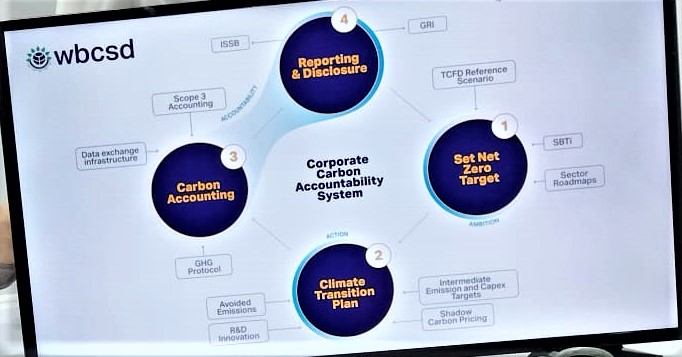
Big political leaders make lofty announcements at COP. Big businesses were racing against each other to announce carbon neutrality targets in last year's COP at Glasgow. Big Multilateral Development Banks make big promises of finance for low carbon and climate adaptive infrastructure in every COP. But there is no standard mechanism or process to check what is happening around these claims in an objective way. Where is the accountability? How do we build a structure that will infuse accountability in climate action? How to get reliable data that will allow third party assessment of the claims? That was the focus of this discussion. 

For private businesses the carbon accounting process is one concrete way by which fulfilment of promises of carbon neutrality can be checked. For me the most interesting slide was what I show in the photograph below. 

Accountability of Carbon neutrality pledges by the private sector

A carbon neutrality pledge is generally aimed at some future date like 2040 or 50 or beyond. This must be backed by an action plan with short term milestones that clearly show the path to be followed. Then standard protocols must be established for carbon accounting - not limited just to direct use of electricity and fossil fuels (what are called Scope 1 and Scope 2 emissions) but also accounting for the indirect emissions from actions such as sourcing of raw materials, construction and maintenance of infrastructure, managing waste on a daily basis and at the end of life of products, contracted out services, etc. (all of these are collectively called Scope 3 emissions). Current carbon accounting standards do not insist on Scope 3 accounting in spite of the fact that for many private sector entities this is the biggest contributor to their carbon footprint. And finally transparent and honest disclosure of the data is also important. 

All of this resonated very well with me because I have been saying more or less the same things for a few years. After Paris Agreement and the 1.5 deg C report by UNFCCC I felt that beyond investing in renewable energy infrastructure etc., the governments will have to eventually demand lowering of emissions by the private sector and might start including such pledges in the NDC. In that case it might become mandatory for companies to report their carbon emissions periodically. To an extent this has started appearing in NDcs from Europe. India cannot be far behind. 

I also felt that as more and more NGOs and institutions engage with the climate change issue, they should 'walk the talk' by going for low carbon operations and presenting the evidence to the world in a transparent way. 

Converting this thinking into action, we conducted a carbon accounting exercise for the headquarters of Laya, the secretariat of INECC. We have also tried to estimate the carbon emissions of some of our meetings and have tried to keep these as low as practically feasible. A few years ago, we launched a participatory process for educational institutions to go for carbon neutrality as a joint project by students, teachers and management, with our role as that of a mentor rather than a consultant. 

However, I could also see that in India we don't have enough people with even a basic understanding of what carbon accounting is - let alone be qualified carbon accountants and auditors. We need to build this basic understanding if carbon accounting is going to be a mainstreamed process in industry, academia and civil society. So, I launched an online course with the limited aim of building 'literacy' about carbon accounting around 2016. 

I in fact thought even beyond the accountability concerns that the panelists talked about. The IPCC Assessment Report 6 clearly stated that even stopping emissions is no longer going to be enough to meet the 1.5 deg C goal of the Paris Agreement. We have to also invest in removal of carbon dioxide from the atmosphere. Currently the only way to do that is to increase the land cover under natural ecosystems to sink the carbon into vegetation. Many of the carbon neutrality pledges are relying on creating carbon sinks. How does one account for that? I feel that the carbon accounting protocols need to include a component to estimate the 'sunk carbon' too. I have tried to include a flavour of that approach in my course. 

We ran the carbon accounting course in a rather amateurish and low-key manner for the past 5-6 years and then COVID happened. It has certainly opened my eyes to the various tools available and possibilities around online education. The course is currently being revamped in collaboration with 'Climatora'. Stay connected with Samuchit Enviro Tech on social media to know more about this! 

In the meanwhile, you can try our personal carbon footprint calculator in its new and revamped version made in collaboration with Climatora on this link.


Priyadarshini Karve
Director, Samuchit Enviro Tech
Convener, Indian Network on Ethics and Climate Change. 

Friday, November 11, 2022

Musings from Priyadarshini Karve: #COP27: Day 4

 #COP27: Day 4


Organising a COP is a huge undertaking for any city and the host country. Tens of thousands of people would be descending on the city over a period of two weeks. There are protocols that need to be followed for heads of states from across the world, as well as their ministers and negotiators. The NGOs and research organisations and businesses that send their delegates are also increasing day by day. Egypt and Sherm al Sheikh have not done a great job with the logistics of the conference unfortunately, but more about this in a later blog! 

Typically, COP tends to take over a city and does not remain limited to the conference venue. There are a number of side events that happen at other venues across the city. There are also a few marches and processions that take the COP to the streets of the city. 

We keep on getting notifications of events happening outside the COP venue but one of those drew our attention due to its unique venue and title. This event was organised by an organisation named 'SISU' and was called Ancient Futures. It was to be held at the Sherm al Sheikh Museum in the evening. So, we decided to look in on it. 

The museum is an imposing building, but we did not go inside it. The event was held on an open terrace outside. The seating arrangement had a few chairs and a few mattresses and pillows. There was some food and beverages on offer for the attendees. 

The event was focused around listening to the voices of women from indigenous communities. We managed to catch the main component of the function which was going to go on for 4 hr. 

The speakers were three indigenous women from South America and Africa. They spoke very eloquently about the relationship of the indigenous people with the earth and specifically about the role of women of the community - which used to be more decisive and equal than modern communities. 

Ancient Futures Event


The argument made by the 'King' (she called herself the king while everyone else referred to her as queen... If one thinks of 'king' as a gender-neutral word for the main leader, her usage of the word was correct - somewhat similar to 'Rashtrapati' in the Indian context.) of a tribe from Africa was interesting. Referring to the history of humanity she asked - aren't we all indigenous people of Africa? Why should we make this distinction between 'indigenous' peoples and others merely on the basis of differences in ways of life? 

The lady from Brazil was recently elected to the Parliament and was a supporter of the newly elected leftist president Lulla. She explained that this time the indigenous communities strategically participated in the elections and took a lot of efforts to get the indigenous people to come out and vote. As a result, the number of elected representatives from the indigenous communities has gone up in the new parliament and hopefully that will help in addressing some of the commercial threats faced by the tribes in the Amazon forests. 

Apart from this the overall tone of the conversation was the usual spiel on how the earth is suffering because the women are suffering etc. 

The issues of gender equality are indeed an important socio-politico-economic challenge. It is not limited to indigenous communities but is far more universal, but yes, the disenfranchisement of indigenous women is far graver and devastating than that of women in the so-called modern societies. Environmental challenges in general and climate change impacts in particular also add to gender inequality. But I fail to understand why people need to respond to these realities from a place of 'emotions' than a place of 'rationality'. I also visited a booth by a US based university, and they are doing a project with young people across the world to help them relate to climate change with their 'hearts'. 

I have always felt that an accurate understanding of the science is a better way to get the heart involved in solving the large complex challenges that we face today. An understanding of the mitochondrial DNA that links all humans to a single ancestral woman that lived in Africa about 500,000 years ago is a more powerful argument for the kinship and therefore equality of all humans than any emotional appeal to the sense of justice and equality. Understanding the intricate feedback loops and connections between the earth's geological, climatic, and biological systems is essential to understanding the importance of maintaining these systems in their current forms for the survival of our species rather than calling the planet 'mother earth' and ourselves its 'protectors' and 'stewards'. 

The solution to climate change will of course need a wide variety of people to be involved in the fight and different things may motivate different people. But it is concerning to me that modern science is often looked upon as a villain as it is perceived as the trigger for the industrial revolution that heralded climate change. But the same industrial revolution also heralded the communication systems that allow us to connect with all humans across the world. The same industrial revolution also helped us overcome many deadly diseases and increased the average life span of humans. 

Solving climate change is not just about going back to the traditional ways of life because the climatic conditions that exist today have not been experienced by humans at all. The solution to climate change will come through a blending of traditional wisdom and modern scientific thinking. The proponents of both should respect and work with each other rather than looking down upon each other.  


Priyadarshini Karve
Director, Samuchit Enviro Tech
Convener, Indian Network on Ethics and Climate Change (INECC)
Thursday, November 10, 2022

Musings from Priyadarshini Karve: #COP27: Day 3

 #COP27: Day 3


9 November 2022 was officially 'Finance Day'. The negotiators discussed finance for mitigation, adaptation and also for 'loss and damage'. The side events of the day were also focused on the theme of finance. 

As we entered the venue we came across an interesting protest displaying a dinosaur and a Pokémon! A number of young activists were speaking on how climate change induced disasters are affecting their countries. The demand of this protest was 'Stop Funding Fossil Fuels'. 

Stop Funding Fossil Fuels! 

I attended two side events - both organised by members of Climate Action Network (CAN) and focused on 'Adaptation' and 'Loss and Damage'. 

I am going to digress a bit and try to explain these terms. 

When it comes to climate action, the media and public discourse is generally focused on 'Mitigation' - reducing greenhouse gas emissions going into the atmosphere. This is important for slowing down future warming of planet earth. This requires moving away from fossil fuel use and change our land use pattern. Most of the climate finance is currently focused on this aspect. 

However there is also 'Adaptation'. The planet is already about 1.1 deg C warmer than the preindustrial era. This has changed the weather patterns and ecosystems around the world permanently. People now have to change their ways and means of life in order to deal with the changes. Some of the challenges may be solved by behavioural change (for example - change the timing of outdoor work to deal with excessively hot summers) but some require use of technology (for example - rainwater harvesting and storage for better water security in spite of the erratic rainfall). Financing for adaptation has been a contentious issue at COPs for a long time. Developed countries have promised big money but actually provided very little. 

A third front on climate action now is 'Loss and Damage'. As global average temperature has creeped up over the last few decades, many communities across the globe are facing an existential crisis (for example - the Maldives will be totally submerged in a decade or so even if all GHG emissions drop to zero today). As sea levels rise, coastal communities lose their lands and homes and therefore their way of life, culture and traditions. They are getting uprooted and displaced. As certain parts of the world are repeatedly hit by cyclones, people are losing lives and livelihoods. For a long time, the developed countries have tried to argue that dealing with such situations also should be considered 'Adaptation' (and therefore no separate funding is needed for this). But the developing countries have strongly argued that 'Loss and Damage' is happening because both 'Mitigation' and 'Adaptation' are failing. Some countries need urgent help while we strengthen the efforts on Mitigation and Adaptation. Finally, this year financing for 'Loss and Damage' is being discussed. The news is that the countries have agreed to put in place a mechanism for this 'no later than 2024'. 

The first side event in the morning was by CANSA (CAN South Asia) of which INECC is a member. There were presentations from Nepal and Bangladesh talking about how localised and community-centric action with co-operation and collaboration of government is helping these two highly affected countries adapt better and thereby minimise loss and damage. This exactly resonated with our own 'LDC for NDC' concept. Both the presentations also strongly highlighted the importance of the support of government machinery from local to national for more effective adaptation at the local level. 

The final speaker of the event was a Minister from Pakistan. Pakistan is proving to be the showcase of 'Loss and Damage' in this COP. As the minister said - the country suffered an extremely hot summer followed by unprecedented and devastating floods during the monsoon season, and now it is entering what is likely to be an extremely cold winter! Climate change is really hammering them hard from all sides! It is no wonder therefore that the Pakistan pavilion has a caption 'Lost and Damaged' prominently on display. 

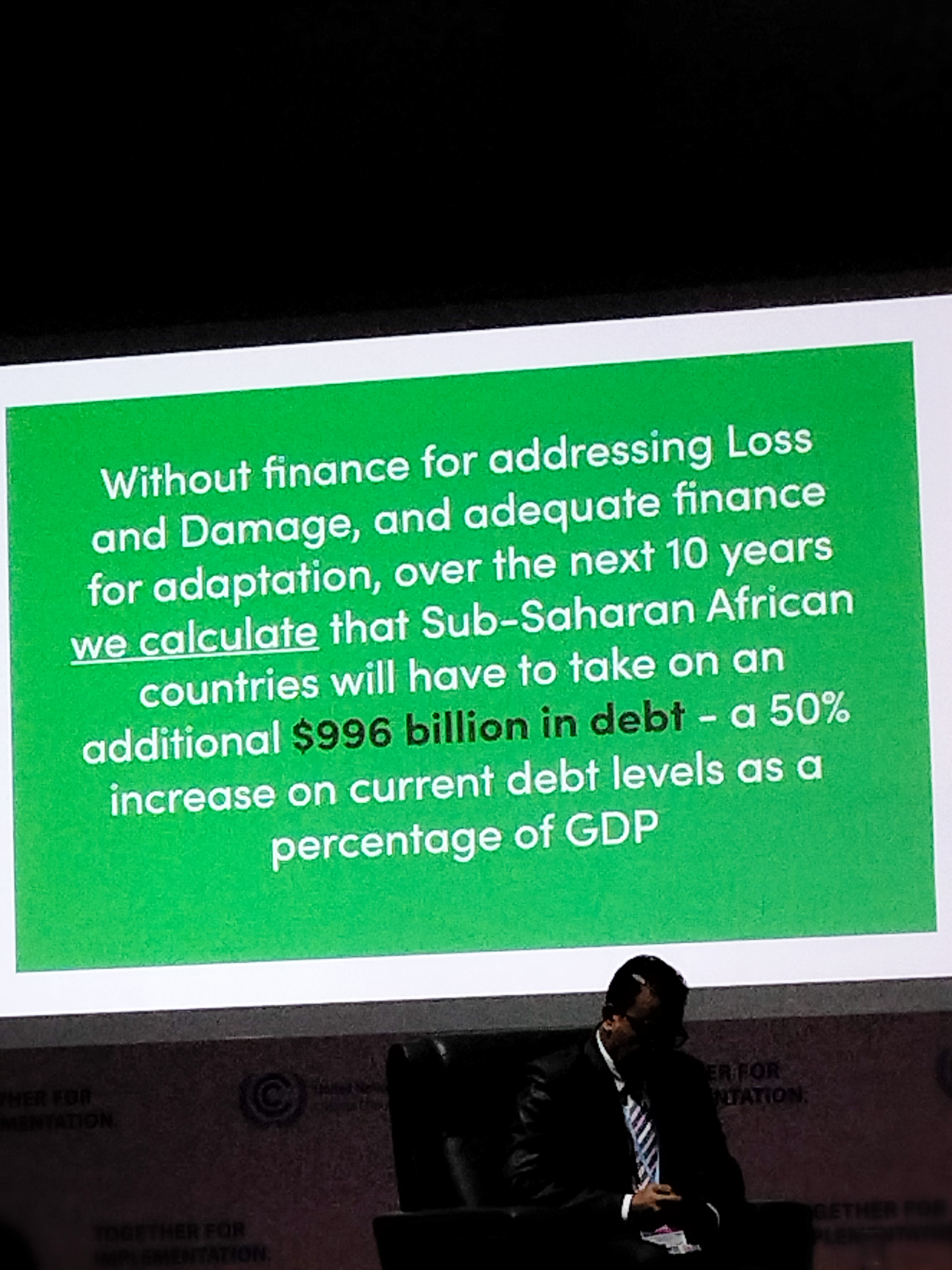
One important point that was made in this side event was around the nature of finance. Even though it is a moral obligation of the developed world to help the developing world deal with climate change, 70% of the climate finance available (of all categories) is in the form of debt and that too at very high interest rates! Strong arguments are therefore being made on all fronts that existing debts be written off and future finance not have a 'debt' component. One slide that presented eye opening statistics in this context is what you can see below. 

The Climate Debt Trap

The second side event was organised by CAN and a few collaborators. Its focus was 'Loss and Damage'. It had presentations from Malawi in Africa and Bangladesh. There were also presentations about how women are more affected than men when it comes to loss and damage. All in all there were very moving presentations starkly highlighting the plight of the vulnerable communities. One important point made was that while a lot of funding pours in for disaster relief when a tragedy strikes, not much finance is available for preventive or preparatory measures. It is hoped that the 'Loss and Damage' funding will address this gap. 

As my colleague Pournima pointed out - often in the discussion on loss and damage, the communities come across as helpless and clueless people doing nothing as disasters creep on them. But the ground reality is that communities can exhibit resilience and resourcefulness. They are not totally without any agency of their own! They of course need a helping hand - in the form of finance as well as in the form of knowledge and data. 

The loss and damage finance facility needs to focus on empowering communities to protect and rescue themselves in a sustainable way. Our 'LDC for NDC' process is showcasing some of the success stories of this approach. 


Day 2 Blog

Day 1 Blog


Priyadarshini Karve
Director, Samuchit Enviro Tech
Convener, Indian Network on Ethics and Climate Change (INECC)

Wednesday, November 9, 2022

Musings from Priyadarshini Karve: #COP27: Day 2

 #COP27: Day 2

8 November 2022, the second day of COP27, was an important day for our team. We were going to kick off the calendar of side events! 

While the UNFCCC COP is primarily about various government representatives negotiating the future of state-lead climate action across the world, the observer organisations attending the conference have their own calendar of events. In this COP we have been assigned a booth for 3 days and we were also allotted a slot for a side event. We had applied for a side event a few months ago, but we were waitlisted (many organisations are keen to have their say on the global platform, however there are space and time constraints). We were finally sanctioned a side event after we agreed to merge with another organisation. This happens a lot of the times and generally the collaborators try to present a single cohesive side event of 1.5 hr duration. Sometimes it does not work out that way - which was our case this time. 

We thus had 45 min to say our piece. As the moderator of the session I am happy to say that everything worked smoothly, the speakers stayed on schedule, and we managed to hand over the stage to the next moderator on the 44th minute. I feel rather proud of our team work and planning that made this work in an effortless manner. 

Laya Side Event COP27: 
From L to R: Nakul Sharma, Martin Voss, Myron Mendes, Priyadarshini Karve

So what was our side event about? 

We talked on 'Locally Developed Choices' for 'Nationally Determined Contributions' - LDC for NDC. This is INECC's current theme of action and we wanted to talk about it with the global audience. The gist of our argument is this: 

Paris Agreement is not just about keeping the warming below 1.5 deg C, it also talks about helping the climate-affected populations for adaptation. However, this aspect has always been ignored by the UN negotiators. This year finally the COP is looking at 'Loss and Damage' (more about this in a latter blog!) but the developing countries really had to struggle hard to get the topic on the discussion agenda. If one looks at the NDCs (commitments by individual national governments under Paris Agreement) these too only talk about mitigation. As a result, when climate change impacts hit locally, communities have to fend for themselves. This is however leading to some innovative choices being developed locally (LDC) that can not only achieve adaptation but also contribute to mitigation. For the last couple of years INECC has been trying to document such LDC and trying to build an awareness raising as well as policy advocacy campaign around these initiatives. 

Laya Side Event @ COP27:
Priyadarshini explaining '
LDC for NDC'
In the side event I explained the 'LDC for NDC' concept with the example of lacunae in India's NDC and also briefly described the work we have done so far on this theme. My colleague Myron Mendes presented the case study of Laya's work on resilience building among the indigenous communities in the Eastern Ghats through technology interventions in agriculture and basic services. Nakul Sharma of Climate Action Network South Asia (CANSA) presented a case study of local action for adaptation from Nepal which described a wonderful collaboration between local community groups and local government. The final speaker was Martin Voss of GermanWatch who talked about how the big multilateral banks can and should fund replication of such success stories... but unfortunately are still stuck in the conventional thinking of pouring money into big infrastructure projects. 

Even though we had 4 speakers and only 45 minutes, we had structured the session in such a way as to keep 10 minutes for questions and comments from the floor. And this turned out to be a very good decision! We had an audience of about 20-30 people. A member of the organisation leading the local action in Nepal was present in the audience and gave some additional detail on the case study presented by Nakul. The theme of LDC for NDC seemed to have really resonated with people from Africa in the audience. A couple of them made very moving comments on personal experiences of how the local reality is being ignored by the state-driven 'climate action'. One audience member pointed out the importance of understanding local vulnerabilities to shape adaptation - basically that funding for adaptation and resilience building must be targeted at ecosystem community level rather than at country level.  

All in all, I can say that we managed to get our point across. We felt highly encouraged by the reactions from the audience and hope to build an international momentum behind LDC for NDC! 

The side event was livestreamed and for those who are interested here is the link. We are in the first 45 min.  


Day 1 Blog


Priyadarshini Karve
Director, Samuchit Enviro Tech
Convener, Indian Network on Ethics and Climate Change (INECC)

Tuesday, November 8, 2022

Musings from Priyadarshini Karve: #COP27: Day 1

 #COP27: Day 1

UNFCCC's annual conference of parties (COP) is held every year during November. While the main work of negotiating for global climate action goes on through diplomatic and ministerial meetings the Observer Organisations (mainly civil society and academic organisations as well as religious faith groups) have the opportunity to connect with like minded people across the world. 

I am here at Sherm Al Sheikh in Egypt for the 27th edition of the COP and as a part of a delegation from 'Laya' the secretariat of Indian Network on Ethics and Climate Change (INECC). 

On Day 1 - 7 Nov 2022 - we primarily set up the exhibition booth which has been allotted to us for 3 days. In the photograph you see us at our stall. 

From L to R: Durgesh of SayTrees, Pournima of Laya, INECC & Samuchit, Priyadarshini of INECC & Samuchit, Myron of INECC & Laya

A little bit of walking around the exhibition booths and various pavilions and soaking up the overall atmosphere and vibe is all I have done on Day 1. 

It is always interesting to visit the various country pavilions. Typically, they follow two approaches. One approach is to create a lot of open space for people to sit and talk and listen to various events happening within the country pavilion. There is some information about the country's climate action but presented subtly through posters etc. Most of the developed country pavilions are in this format. The other approach is to flamboyantly display the past and present of the country and create a welcoming vibe to tempt people to drop in and have a chat. Some also offer souvenirs from the country. This is the format followed by the developing countries generally.  

India pavilion however does neither which is perhaps appropriate as we are always in this identity crisis of whether we are developed or developing! The pavilion is a very officious and high-tech display of central government schemes contributing to climate action. There are slogans everywhere about how India's climate action is 'people-centric' but there are hardly any 'people' in the overall display. There is a closed seating area at the back for interactions being held within the pavilion. It is a tiny space with just about 20 chairs... Not expecting a lot of audience for events in the pavilion perhaps? 

A view of the India Pavilion at COP27

We have an official side event coming up on Day 2. Based on the calendar put out by UNFCC this will be the first side event of this COP and we have been assigned a 150-seater room for this. If you have any friends or colleagues at COP27 please ask them to drop by! The event is open to all registered delegates. 

Laya - INECC Side Event Invitation

Priyadarshini Karve
Director, Samuchit Enviro Tech
Convener, Indian Network on Ethics and Climate Change (INECC)
Friday, September 13, 2019

INECC Talks by Ajita Tiwari: Towards Raising Regional Climate Ambition in the Asia Pacific - Where is the race?

I had the opportunity to participate at The Asia Pacific Climate Week ( APCW) 2019 which was designed to advance regional climate action. This was aimed to support the implementation of Asia Pacific countries Nationally Determined contributions ( NDCS) under the Paris Agreement ( PA) on Climate change and action to deliver on the Sustainable Development Goals ( SDGs). APCW was envisioned as a stepping stone to the 2019 “Climate Action Summit in New York- A race we can win, A race we must win” .

This UNFCCC led conference was timed when climate emergency is upon us, at a time where countries in the Asia Pacifc region face new climate realities, where surprise is the new normal, hazards are less predictable, exposure is growing and vulnerability is compounding. The region has been battered by disasters and extreme events; vulnerability is growing and is almost double in the region, with rising economic losses. The 2019 Asia Pacific Disaster report shows that the region is at risk and is running out of time. It also points out that climate risks account for 85% of the region’s losses.

The deliberations at APCW were organized across nine themes including Raising ambition and NDC implementation, energy and industry transition, nature based solutions, infrastructure, cities and local action including building and transport and climate finance. Most of the session were “closed” ( read ‘by invitation only’), and our engagement therefore was limited to the platforms of the ‘Action Hub’ , where my colleague, Siddharth D’Souza presented on a waste to energy project; the Knowledge Corner, which served as an excellent space for sharing and networking. The other learning and updating space was from the side events and a few plenaries.

Ajita Tiwari (left) and Nafisa D'Souza (right) at the Knowledge Corner
Siddharth D'Souza presenting at the Action Hub

In this blog I share a few thoughts that emerged while attending a few sessions. The discussion on cities interested me as we ourselves are engaged with the discourse on ‘sustainably smart cities’ in India along with emerging discussions on technology and reflections on adaptation and resilience.

The City Paradigm: 

With diverse cities like Beijing, Mumbai, Dhaka and Osaka in the region the discussions highlighted the challenges for a low carbon, inclusive and just transition in the context of growing socio economic pressures (continuous inflow of migrants) and frequent disasters. While it was understood that the cities are gearing up for action and city mayors are motivated to take climate actions, the understanding of cities from the perspective of ‘limits to growth’ was challenged. In the current paradigm where cities are seen in isolation with its immediate peri urban and rural communities, forces us to think as to what extent and how long can the city take the pressure? Unless, of course we change the paradigm of looking at cities. The need to look at the urban, peri urban – rural interlinkages and understand interactions of energy, food- water- manpower, resources etc. While theoretically this makes perfect sense, the challenges lies in its operationalization, i.e governance. In the current paradigm with sharply defined jurisdiction of cities and villages, blurring of jurisdiction is not easy, in the way we operate. For the urban – peri urban – rural – tribal continuum, the key is overhauling the governance: defining the limits to growth of the city, recalibrating the resource pool, the infrastructure need, considering new skills and capacities, building in effective vertical integration, bringing in new partnerships and draw the low carbon city development plan benefitting all. While this looks to be daunting and time consuming, a thought that immediately comes to mind is that is city retrofitting even possible - A retrofit, that is not only disaster proof, low carbon, resilient but also promises development for all? 

Resilience , Inclusion and Empowerment : Empower the poor with big data and technologies 

My understanding of technologies so far has been centered around decentralized community based low carbon interventions which meets peoples’ needs  in climate friendly ways. However, the emerging understanding of technology at the APCW certainly overwhelmed me. It pointed towards fast paced, giant leaps that technology was making for addressing the climate crisis. Technological innovations like the Big data, digital identity systems, risk analytics and geo spatial data seemingly offers unprecedented promise to reduce barriers in information flow to include and empower the community at risk. While we need to catch up more on this aspect, the need to empower ourselves first to be then able to empower the community seems like the way forward.

Standee highlighting emerging technologies to address climate change  
(outside conference room 2, ESCAP, Bangkok)

Science Based Adaptation: It’s about communities… 

A lot of discussions centered around riskscapes and the need to invest in resilience to outpace risks, to develop risk informed system based approaches for scientific adaptation planning and decision making. These typically include 
i. Understanding local realities: What kind of risks are the communities facing? 
ii. Understanding and defining tipping points within the community and ecosystem context,
iii. Understanding slow onset of events in micro climate of our areas of operation while also understanding impact on ecosystem services. 

However, at the very core lies the question of how do we translate this science into adaptive and resilient solutions? Solutions, that mould communities into green and resilient communities. Financial institutions seem to have come to the rescue by demanding for “bankable" adaptation projects. The idea of “bankability" stumps us, those of us who work with the communities given the fact that one has to prove the bankability of adaptive projects for communities who have been the least contributors to the climate crisis. The first generation adaptive responses just cannot afford not be resilient enough because time is running out and economics fail us in the long run. The idea of bankability needs a serious rethinking in contexts where community based adaptive project is crucial for their very survival.

The issue of resilience building becomes even more tricky in a situation which is ever dynamic, and where science is bringing in new data. New data and information requires new changes to design adaptation actions, and new adjustments to be made. Adjusting very fast to the evolving changes is the key to thrive but the moot question is how do we go about doing this? Are our systems equipped enough to respond to this dynamism? therefore how do we institutionalise this dynamic nature in the government decision making systems?

Can we consider context specific climate finance instruments ( some refer to this as blended finance at the provincial level) to better serve and respond to the dynamic adaptation contexts of the communities?

The recommendations from the APCW is expected to feed into the climate Action summit. The Climate Action summit tagline is “A race we can win". At the APCW at least the ‘race’ was certainly not evident with almost no concrete conclusions on raising ambition in NDCs even by high emitting countries in the region. I would rather say that the race should at least begin, if we are looking to meet the urgent need to address climate change, foster resilience, achieve the goals of the Paris Agreement, and meet the Sustainable Development Goals.

We hope the passionately expressed words of the youth participants at the APCW would drive ambition and trigger action by the countries before it is too late! 

---
Ajita Tiwari Padhi
National Facilitator,
Indian Network on Ethics and Climate Change (INECC)
Email: inecc1996@gmail.com
c/o INECC Secretariat
Laya Resource Center
Plot No. 110, Yendada,
Near Senora Beach Resorts,
Visakhapatnam-530045

Saturday, December 8, 2018

INECC Talks by Ajita Tiwari: No Rulebook without Equity


The 24th meeting of the Conference of Parties (CoP 24) is the most important CoP after CoP 22 at Paris. This is taking place from December 2-14, 2018, at Katowice, Poland. Katowice has a daunting mandate - to finalise the Rule Book for implementation of the 2015 Paris Agreement.

The irony of a coal city hosting the Climate Talks

The host city for CoP 24 is Katowice, a small city with a population of over 3,00,000. This city falls in the central region of Silesia which is the industrial belt due to rich natural and mineral deposits. Katowice too sits on a lucrative coal deposit and gets 80 percent of its energy from coal. The influence of the coal lobby seems quite significant from the fact that three polish coal companies have sponsored this CoP. So while on one hand, we continue to ask ourselves why ‘green talks’ in a ‘dirty’ city, the choice of the venue is even more intriguing as busloads of delegates like us travel over an hour and more each day, either way to reach the spaceship shaped conference venue!

In this context, it is important to highlight what the Polish president Andrzej Duda had to say at the press conference on the opening day of the conference. He said “we have coal deposits that will last 200 years,”. “It would be hard to expect us to give up on it totally.” This perspective begs the question as how this aligns with the by-line of this CoP which is“Changing Together- for a Just Energy Transition’. The President’s statement sends quite a confusing message to the outside world, who would get the idea that it is okay to burn coal and build more coal fired plants while also take climate actions. Statements like these, clearly refute the urgency and warning highlighted in the latest IPCC special report on 1.5 deg which calls for unprecedented transitions and demands carbon dioxide emissions to decrease by 45 % from 2010 levels by 2030, and reaching net zero by 2050.

Postcard from an Exhibit Booth no 112 at CoP 24 , week 1

Rulebook must include equity

While we try hard to make sense of Poland’s narrative, an interview with a Swedish radio this morning, forced me to look at India’s narrative at the CoP, especially from the lens of equity.

Considering that we were representing the civil society organisations (CSOs) the Swedish Radio interviewer, Ms. Magnolia Schiktter was interested in understanding the position of Indian CSOs and their expectation at the CoP on equity for a story that they were compiling. I took this opportunity to articulate what Indian Network on Ethics and Climate Change (INECC) desires from this CoP and what it wants the Indian Civil society and its government to do.

The rule book being developed at Katowice, to operationalize Paris Agreement (PA) has to reflect equity. The achievements if we may say so, of Paris process needs to be protected and for that to happen ‘equity” and Common but differentiated responsibility (CBDR) must not be eroded. We completely reject the notion of CRRC (common responsibility according to respective capabilities) which has been advanced by the developed countries as an alternative to CBDR. The attempt by developed nations to not have differentiation and promote “responsibility sharing” without differentiating the responsibility between developed and developing nations has to be constantly opposed. The ‘common responsibility’ idea that has stemmed from the fact that some major developing countries (includes India and China in particular) are responsible for current emissions. India and other developing countries are rightly arguing for the ‘fair share approach’ which the developed countries have wanted to do away with. The attempt of the developed countries to have the PA as a completely new treaty, delinked from the 1992 convention was largely to do away with its accountability for historical emissions. While in the run up to PA, the notion of ‘equitable access to atmospheric space’ was gradually subsumed into ‘equitable access to sustainable development’ which in turn was gradually lost in the bottom up process of the Nationally Determined Contributions (NDCs). We know that the process has been an inequitable one. We are aware of the gap that exists between the current NDCs targets and what is needed to limit temperature rise to 2 deg. By putting the equity rationale under the rug, and bringing in the ‘shared responsibility’ logic, would mean that the developing countries like India will need to push themselves that extra extra mile to fill in the gap created by developed countries. India and the bunch of ‘Like Minded Developing Countries’ (LMDCs) must ensure that this must not happen. This is contrary to the convention and the PA.

Associated with the position of equity, is the pre 2020 commitments which might get spilled over and shifted to developing countries in their post 2020 trajectories. It is important to mention that it has become quite common to quote the United Nations Environment Programme (UNEP) ‘Emissions Gap Report’ especially by the developed countries in all such meetings. This report lays down what is being done on emission reduction and what more needs to be done to close the gap. This mostly highlights that all countries need to do more on emission reduction, without looking at who is not doing their fair share consistent with their historical responsibility. This is certainly not in line with the equity narrative and the burden of closing the gap should not be ours.

Civil society like us must come together and must expose the developed countries that they are doing far too little in terms of what is demanded by science and the latest 1.5 deg report. CSO must emphasize the fact that the actions of the developed countries are not consistent with equity and fair share. However, having said this, it is important to highlight that the observer status given to CSOs at the UNFCCC has become no less than a joke, with literally no mandate. The observers with yellow ID cards are kept out of bounds from all the key meetings and hardly have any say. But before we feel completely disillusioned by the observer status, we should find comfort in what was said by Dr. Saleem Ul Huq during our side event on the first day of the CoP. He said that it’s not our job to read the text, it’s that of the negotiators. We (civil society) should aim to meet as many people, groups and networks to learn and share from each other, explore collaborations and partnerships.

The final point on equity is Climate finance which has so far been the trickiest of all issues. Against the backdrop of a series of disasters that has battered India, with only over a degree of temperature rise; the latest being the one in the southern part of the country in Kerela, there is no doubt that India is vulnerable to the impacts of Climate Change. Provision for climate finance is one key Means of Implementation (MoI) to operationalizing equity, which also finds a mention in Article 9 of the PA. Countries like India with a large poor population will be unable to do much with only domestic resources unless supported through financial mechanisms that respond to adaptation and mitigation together with loss and damage issues of its most vulnerable communities. In this context we hope that discussions on raising the floor for climate finance and predictable financial inflows will go a long way in operationalizing equity and making effective climate responses.

While the Katowice CoP is all about the rulebook, it is important that equity is integrated in the negotiations of the guidelines and procedures to be ready for the implementation of the PA.

What does India want?

However, I realized that discussion on equity becomes challenging in the backdrop of the glitzy Indian Pavilion that delegates are often heard raving about. India conveys a very glossy impression of itself at this global platform through its Pavilion (see Priyadarshini's blog). The pavilion is themed “One World One Sun One Grid”. India seems to have taken the theme a wee bit too seriously as sitting in the cramped space is literally like being under the sun while outside temperatures mostly are subzero!

Inside view of the Indian Pavilion: Session on Climate Resilient Agriculture, December 7, 2018
---
Ajita Tiwari Padhi
National Facilitator,
Indian Network on Ethics and Climate Change (INECC)
Email: inecc1996@gmail.com
c/o INECC Secretariat
Laya Resource Center
Plot No. 110, Yendada,
Near Senora Beach Resorts,
Visakhapatnam-530045


Tuesday, November 27, 2018

My City My Responsibility - Youth for Climate action Part I

A casual group photo at CEE
Dear All, 

I am very excited to share with you the insights of a Youth Conference that I attended last week in Ahmedabad, Gujarat. It was the Local Conference for Youth (LCOY 14) for South Asia region hosted by Centre for Environment Education (CEE) in Ahmedabad. The theme of this conference was what actions the youth of the country can take in order to have a low carbon future. Students, budding environment entrepreneurs, researchers, PHD scholars and professionals from all over India and Bangladesh participated in this conference. Being a South Asia regional conference participants from Nepal, Afghanistan and Pakistan were also supposed to attend but couldn't make it this time. So we were a cozy group of around 30 Climate enthusiasts for the conference.  

As a researcher working in the field of Climate action I have been curious about what exactly happens at the Conference of Parties (COP) especially after the  COP21 at Paris that led to a landmark agreement bringing all the nations together to combat climate change and accelerate actions for a sustainable low carbon future. When I heard about LCOY last year my curiosity had been awakened. and I wanted to know more about it. That's when I learnt that Conference of Youth (COY) happens within the United Nations Framework Convention on Climate Change (UNFCCC) and aims at engaging youth for understanding the climate negotiations happening at the global level in COP and strengthens the capacity for actions at the local level. 

LCOY provides an opportunity where all the initiatives and research happening at local level towards climate change impacts are discussed, compiled and presented at the GCOY i.e the Global Conference for Youth. The GCOY takes place before or during the COP every year. This year GCOY will be happening around 29th November ahead of COP24 in Katowice, Poland. I am glad that I could attend LCOY this year and could share our work on climate vulnerability and low carbon lifestyles choices. I really hope these suggestions get discussed in this year's COP.

At the COP, LCOY India is endorsed by YOUNGO which is an official constituency of UNFCCC and is a dynamic network of individuals and organizations focused on youth for climate action. YOUNGO has been accredited a status of  'Observer' at the COP and presents all the inputs from the LCOY's at the GCOY.  It was overwhelming to meet the south coordinator of YOUNGO - Yugratna Srivastava  in this conference. 

On the first day, after all the introductions and background, one of the activities involved role playing. Here we actually got a hang of what happens at the COP through mock climate negotiations. We all were grouped as different regional groups known as Party Groupings. The regional groups include G77+ China - a group that comprises of developing nations (India is included in this group), the like minded developing countries (LMDC's), Least Developed Countries (LDC's) and the Small Island Developing States (SIDS) - one of the biggest group of nations. Then there is the African Group of Negotiators, the EU group comprising 28 member states of European union, an Umbrella group consisting of US and Russia predominately, the Environmental Integrity group comprising the Mexico, Korea and Switzerland etc. While there are some non party groups as well known as the Observers which includes all the non formal associations like NGO's, activists, professionals etc. 

I was a part of the G77+China group where we all had to advocate for the voices of the LMDC's who were struggling to just survive in the face of the climate change impacts, to other climate negotiators. We had a great debating session. I realised how important it is to have knowledge of country statistical data in putting forth one's point strongly. Moreover, I realized that the job of a negotiator representing his/her country is highly critical, knowledge based, political, diplomatic and absolutely risky. There may be more to it for sure. I also realised how tricky it is to come to a consensus for any single given issue. The mock took almost two hours for us as party groups, to come to a consensus on the single issue of deciding what should be the limits for the global temperature rise in this century. Should it be below 2 degree Celsius or  well below 1.5 deg Celsius??? Tuff job!

I am going to write more about my reflections on the other sessions at LCOY, some highlights and views on the Sabarmati riverfront development and the city of Ahmedabad in general in my next blogs. Stay tuned!

Pournima Agarkar. 
www.samuchit.com   

Tuesday, August 7, 2018

My City My Responsibility - Carbon Accounting Online Course

Dear All, 


Regarding action towards Climate change, India has committed to the Paris Agreement in December 2015, where India will have to measure, regulate and report it carbon emissions. In order to have an Climate friendly development, India has submitted its Nationally determined contributions (NDCs) to the United Nations framework Convention on Climate Change (UNFCCC). The NDCs are climate actions taken by the country considering its socio-economic and environmental conditions for reducing emissions and undertaking measures for adaptation and mitigation of climate change impacts. We understand that, in order to reduce emissions it is important to know how much we are emitting? For the same purpose, all the institutions or organizations may have to measure and perhaps report their emissions to their clients/donors/investors/government agencies, post 2020 when the Paris Agreement will be operational. In order to get the hang of accounting of our own carbon emissions, we at Samuchit have come up with an opportunity for all of you. 

Samuchit is organizing an online training program on Carbon Accounting. The online course will cover all the basics from understanding the science behind climate change, its economics and politics, mitigation and adaptation measures, to carbon footprinting for an individual, or an household or any activity, institution, process or any event considering the scope 1, 2 and scope 3 emissions. Anyone who is involved in working with sustainability or environmental issues like green entrepreneurs, architects, urban planners, researchers, academicians or freelance environment consultants can join this program. Since the course will be conducted in online mode it enables homemakers, work from home professionals as well as full time professionals anywhere in India to access the course. All you need is a laptop or a computer having Microsoft excel and reasonably good internet connection. The course will be divided into five modules, each module will last for a month so accordingly it will take about five months for you to complete the course. However assignment submission within the given time-frame is crucial for accessing the next module, depending on when you submit your assignments, the course may take longer. In that case, there may be additional charges. You will get a certificate at the end of this course. 

So, if you feel that you can contribute to solution to climate change and want to become a climate conscious individual or institution/organization this course is for you. It may not make you an instant expert, but will give you sufficient understanding of the basics to understand what the experts are talking about. 

Kindly send in your entries to me on or before 15th August, 2018 and I will send you the registration form for enrolling yourself in the course or if you have any queries write to me at 
pournima@samuchit.com

Basic online course on Carbon Accounting brochure

Pournima Agarkar.