Thursday, November 10, 2022

Musings from Priyadarshini Karve: #COP27: Day 3

 #COP27: Day 3


9 November 2022 was officially 'Finance Day'. The negotiators discussed finance for mitigation, adaptation and also for 'loss and damage'. The side events of the day were also focused on the theme of finance. 

As we entered the venue we came across an interesting protest displaying a dinosaur and a Pokémon! A number of young activists were speaking on how climate change induced disasters are affecting their countries. The demand of this protest was 'Stop Funding Fossil Fuels'. 

Stop Funding Fossil Fuels! 

I attended two side events - both organised by members of Climate Action Network (CAN) and focused on 'Adaptation' and 'Loss and Damage'. 

I am going to digress a bit and try to explain these terms. 

When it comes to climate action, the media and public discourse is generally focused on 'Mitigation' - reducing greenhouse gas emissions going into the atmosphere. This is important for slowing down future warming of planet earth. This requires moving away from fossil fuel use and change our land use pattern. Most of the climate finance is currently focused on this aspect. 

However there is also 'Adaptation'. The planet is already about 1.1 deg C warmer than the preindustrial era. This has changed the weather patterns and ecosystems around the world permanently. People now have to change their ways and means of life in order to deal with the changes. Some of the challenges may be solved by behavioural change (for example - change the timing of outdoor work to deal with excessively hot summers) but some require use of technology (for example - rainwater harvesting and storage for better water security in spite of the erratic rainfall). Financing for adaptation has been a contentious issue at COPs for a long time. Developed countries have promised big money but actually provided very little. 

A third front on climate action now is 'Loss and Damage'. As global average temperature has creeped up over the last few decades, many communities across the globe are facing an existential crisis (for example - the Maldives will be totally submerged in a decade or so even if all GHG emissions drop to zero today). As sea levels rise, coastal communities lose their lands and homes and therefore their way of life, culture and traditions. They are getting uprooted and displaced. As certain parts of the world are repeatedly hit by cyclones, people are losing lives and livelihoods. For a long time, the developed countries have tried to argue that dealing with such situations also should be considered 'Adaptation' (and therefore no separate funding is needed for this). But the developing countries have strongly argued that 'Loss and Damage' is happening because both 'Mitigation' and 'Adaptation' are failing. Some countries need urgent help while we strengthen the efforts on Mitigation and Adaptation. Finally, this year financing for 'Loss and Damage' is being discussed. The news is that the countries have agreed to put in place a mechanism for this 'no later than 2024'. 

The first side event in the morning was by CANSA (CAN South Asia) of which INECC is a member. There were presentations from Nepal and Bangladesh talking about how localised and community-centric action with co-operation and collaboration of government is helping these two highly affected countries adapt better and thereby minimise loss and damage. This exactly resonated with our own 'LDC for NDC' concept. Both the presentations also strongly highlighted the importance of the support of government machinery from local to national for more effective adaptation at the local level. 

The final speaker of the event was a Minister from Pakistan. Pakistan is proving to be the showcase of 'Loss and Damage' in this COP. As the minister said - the country suffered an extremely hot summer followed by unprecedented and devastating floods during the monsoon season, and now it is entering what is likely to be an extremely cold winter! Climate change is really hammering them hard from all sides! It is no wonder therefore that the Pakistan pavilion has a caption 'Lost and Damaged' prominently on display. 

One important point that was made in this side event was around the nature of finance. Even though it is a moral obligation of the developed world to help the developing world deal with climate change, 70% of the climate finance available (of all categories) is in the form of debt and that too at very high interest rates! Strong arguments are therefore being made on all fronts that existing debts be written off and future finance not have a 'debt' component. One slide that presented eye opening statistics in this context is what you can see below. 
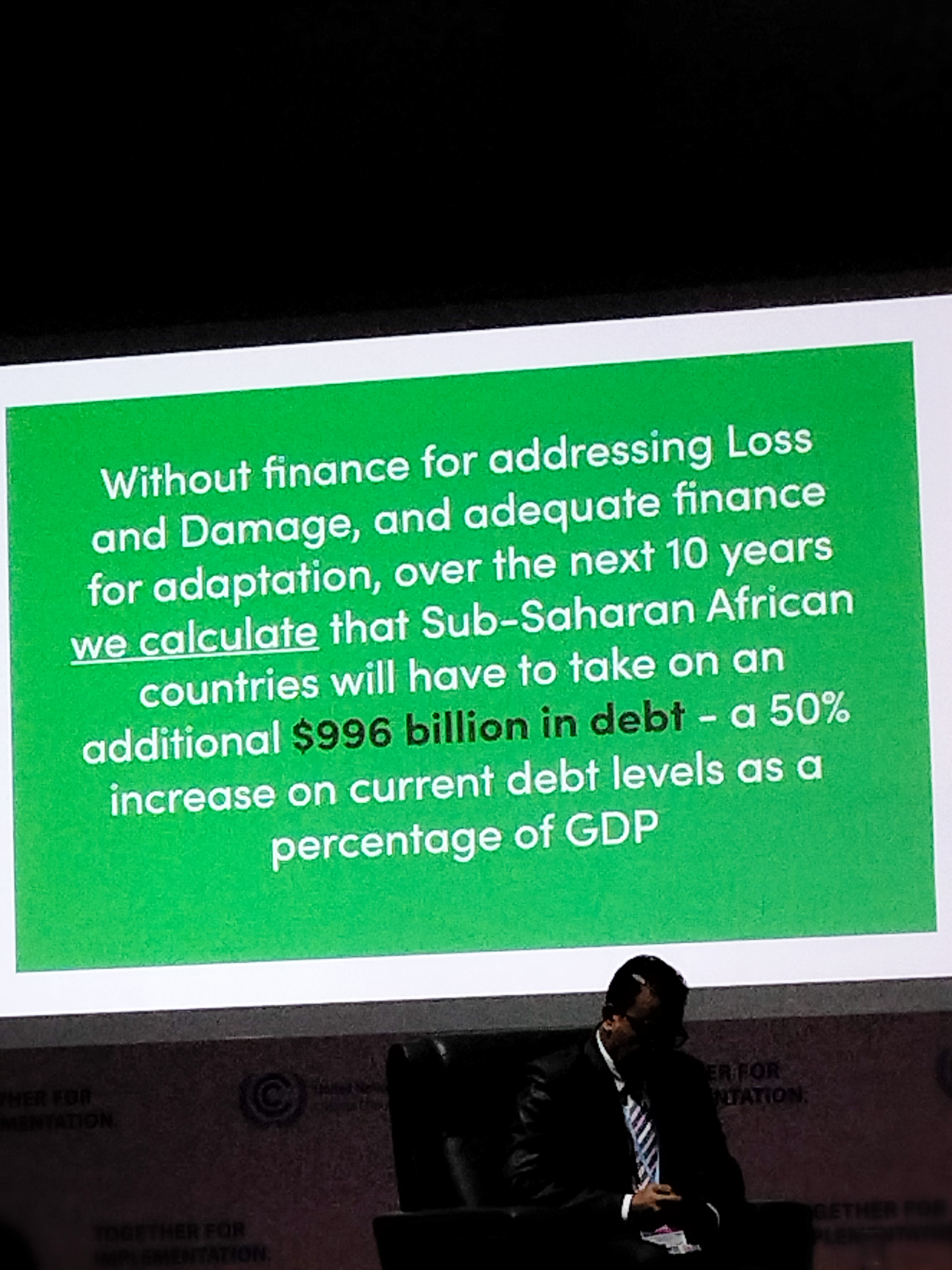
The Climate Debt Trap

The second side event was organised by CAN and a few collaborators. Its focus was 'Loss and Damage'. It had presentations from Malawi in Africa and Bangladesh. There were also presentations about how women are more affected than men when it comes to loss and damage. All in all there were very moving presentations starkly highlighting the plight of the vulnerable communities. One important point made was that while a lot of funding pours in for disaster relief when a tragedy strikes, not much finance is available for preventive or preparatory measures. It is hoped that the 'Loss and Damage' funding will address this gap. 

As my colleague Pournima pointed out - often in the discussion on loss and damage, the communities come across as helpless and clueless people doing nothing as disasters creep on them. But the ground reality is that communities can exhibit resilience and resourcefulness. They are not totally without any agency of their own! They of course need a helping hand - in the form of finance as well as in the form of knowledge and data. 

The loss and damage finance facility needs to focus on empowering communities to protect and rescue themselves in a sustainable way. Our 'LDC for NDC' process is showcasing some of the success stories of this approach. 


Day 2 Blog

Day 1 Blog


Priyadarshini Karve
Director, Samuchit Enviro Tech
Convener, Indian Network on Ethics and Climate Change (INECC)

Wednesday, November 9, 2022

Musings from Priyadarshini Karve: #COP27: Day 2

 #COP27: Day 2

8 November 2022, the second day of COP27, was an important day for our team. We were going to kick off the calendar of side events! 

While the UNFCCC COP is primarily about various government representatives negotiating the future of state-lead climate action across the world, the observer organisations attending the conference have their own calendar of events. In this COP we have been assigned a booth for 3 days and we were also allotted a slot for a side event. We had applied for a side event a few months ago, but we were waitlisted (many organisations are keen to have their say on the global platform, however there are space and time constraints). We were finally sanctioned a side event after we agreed to merge with another organisation. This happens a lot of the times and generally the collaborators try to present a single cohesive side event of 1.5 hr duration. Sometimes it does not work out that way - which was our case this time. 

We thus had 45 min to say our piece. As the moderator of the session I am happy to say that everything worked smoothly, the speakers stayed on schedule, and we managed to hand over the stage to the next moderator on the 44th minute. I feel rather proud of our team work and planning that made this work in an effortless manner. 

Laya Side Event COP27: 
From L to R: Nakul Sharma, Martin Voss, Myron Mendes, Priyadarshini Karve

So what was our side event about? 

We talked on 'Locally Developed Choices' for 'Nationally Determined Contributions' - LDC for NDC. This is INECC's current theme of action and we wanted to talk about it with the global audience. The gist of our argument is this: 

Paris Agreement is not just about keeping the warming below 1.5 deg C, it also talks about helping the climate-affected populations for adaptation. However, this aspect has always been ignored by the UN negotiators. This year finally the COP is looking at 'Loss and Damage' (more about this in a latter blog!) but the developing countries really had to struggle hard to get the topic on the discussion agenda. If one looks at the NDCs (commitments by individual national governments under Paris Agreement) these too only talk about mitigation. As a result, when climate change impacts hit locally, communities have to fend for themselves. This is however leading to some innovative choices being developed locally (LDC) that can not only achieve adaptation but also contribute to mitigation. For the last couple of years INECC has been trying to document such LDC and trying to build an awareness raising as well as policy advocacy campaign around these initiatives. 

Laya Side Event @ COP27:
Priyadarshini explaining '
LDC for NDC'
In the side event I explained the 'LDC for NDC' concept with the example of lacunae in India's NDC and also briefly described the work we have done so far on this theme. My colleague Myron Mendes presented the case study of Laya's work on resilience building among the indigenous communities in the Eastern Ghats through technology interventions in agriculture and basic services. Nakul Sharma of Climate Action Network South Asia (CANSA) presented a case study of local action for adaptation from Nepal which described a wonderful collaboration between local community groups and local government. The final speaker was Martin Voss of GermanWatch who talked about how the big multilateral banks can and should fund replication of such success stories... but unfortunately are still stuck in the conventional thinking of pouring money into big infrastructure projects. 

Even though we had 4 speakers and only 45 minutes, we had structured the session in such a way as to keep 10 minutes for questions and comments from the floor. And this turned out to be a very good decision! We had an audience of about 20-30 people. A member of the organisation leading the local action in Nepal was present in the audience and gave some additional detail on the case study presented by Nakul. The theme of LDC for NDC seemed to have really resonated with people from Africa in the audience. A couple of them made very moving comments on personal experiences of how the local reality is being ignored by the state-driven 'climate action'. One audience member pointed out the importance of understanding local vulnerabilities to shape adaptation - basically that funding for adaptation and resilience building must be targeted at ecosystem community level rather than at country level.  

All in all, I can say that we managed to get our point across. We felt highly encouraged by the reactions from the audience and hope to build an international momentum behind LDC for NDC! 

The side event was livestreamed and for those who are interested here is the link. We are in the first 45 min.  


Day 1 Blog


Priyadarshini Karve
Director, Samuchit Enviro Tech
Convener, Indian Network on Ethics and Climate Change (INECC)

Tuesday, November 8, 2022

Musings from Priyadarshini Karve: #COP27: Day 1

 #COP27: Day 1

UNFCCC's annual conference of parties (COP) is held every year during November. While the main work of negotiating for global climate action goes on through diplomatic and ministerial meetings the Observer Organisations (mainly civil society and academic organisations as well as religious faith groups) have the opportunity to connect with like minded people across the world. 

I am here at Sherm Al Sheikh in Egypt for the 27th edition of the COP and as a part of a delegation from 'Laya' the secretariat of Indian Network on Ethics and Climate Change (INECC). 

On Day 1 - 7 Nov 2022 - we primarily set up the exhibition booth which has been allotted to us for 3 days. In the photograph you see us at our stall. 

From L to R: Durgesh of SayTrees, Pournima of Laya, INECC & Samuchit, Priyadarshini of INECC & Samuchit, Myron of INECC & Laya

A little bit of walking around the exhibition booths and various pavilions and soaking up the overall atmosphere and vibe is all I have done on Day 1. 

It is always interesting to visit the various country pavilions. Typically, they follow two approaches. One approach is to create a lot of open space for people to sit and talk and listen to various events happening within the country pavilion. There is some information about the country's climate action but presented subtly through posters etc. Most of the developed country pavilions are in this format. The other approach is to flamboyantly display the past and present of the country and create a welcoming vibe to tempt people to drop in and have a chat. Some also offer souvenirs from the country. This is the format followed by the developing countries generally.  

India pavilion however does neither which is perhaps appropriate as we are always in this identity crisis of whether we are developed or developing! The pavilion is a very officious and high-tech display of central government schemes contributing to climate action. There are slogans everywhere about how India's climate action is 'people-centric' but there are hardly any 'people' in the overall display. There is a closed seating area at the back for interactions being held within the pavilion. It is a tiny space with just about 20 chairs... Not expecting a lot of audience for events in the pavilion perhaps? 

A view of the India Pavilion at COP27

We have an official side event coming up on Day 2. Based on the calendar put out by UNFCC this will be the first side event of this COP and we have been assigned a 150-seater room for this. If you have any friends or colleagues at COP27 please ask them to drop by! The event is open to all registered delegates. 

Laya - INECC Side Event Invitation

Priyadarshini Karve
Director, Samuchit Enviro Tech
Convener, Indian Network on Ethics and Climate Change (INECC)

Saturday, June 25, 2022

My City My Responsibility - River Rejuvenation Campaign#3

 We at Samuchit Enviro Tech, Indian Network on Ethics and Climate Change (INECC) and Jeevitnadi Living River Foundation are opposing the Riverfront Development plan being enforced by the Pune Municipal Corporation. Since the plan totally disregards river ecology and impacts of climate change we want the project to be cancelled and a genuinely nature-aligned river rejuvenation undertaken in a democratic and transparent manner.

समुचित एन्व्हायरो टेक, इंडियन नेटवर्क ऑन एथिक्स अॅंड क्लायमेट चेंज (आयनेक) आणि जीवितनदी लिव्हिंग रिव्हर फाउंडेशन या सर्व संस्था पुणे मनपा पुढे रेटू पहात असलेल्या नदीकाठ विकास प्रकल्पाला विरोध करत आहेत. या प्रकल्पात नदीची परिसंस्था व जागतिक वातावरण बदलाचे परिणाम यांच्याकडे पूर्णतः दुर्लक्ष केलेले असल्याने हा प्रकल्प रद्द करावा व लोकशाही पध्दतीने व पारदर्शकपणे सच्चे निसर्ग-पूरक असे नदी पुनरुज्जीवन हाती घ्यावे ही आमची मागणी आहे.


Image 3 - Natural Rejuvenation


PMC or Rejuvenation?

Beauty is in the eye of the beholder! A structured and manicured garden may look good for
a while but will become boring soon. But the wilderness of a natural forest simply lifts your spirit! A beautiful array of built-embankments with artificially carved out spaces for human recreation makes a pleasing image indeed. But then the natural beauty of a meandering free flowing river between naturally wild riverbanks too energizes us! So how do we say what is right and what is wrong?? 
The real question to ask is not what looks beautiful on paper today but which of these images is
long lasting and sustainable say beyond a decade from now? 
Constructed structures are always trying to hold back nature. They need constant service and
maintenance. As the city’s financial fortunes ebb and flow and political priorities swing between
two extremes, the beautifully constructed structures are at a high risk of falling into disrepair in a
decade or so.
Water made artificially still will stagnate and become polluted. Natural constructs on the other hand
are by default aligned with the forces of nature. These ‘greenscapes’ will change too but in harmony
with natural forces. The free-flowing river teeming with natural life will keep on self-cleaning itself.
What the river needs is REMOVAL of human interference rather than excessive heavy-handed
attempts to ‘tame’ it! A free river will endow the settlement on its banks with beauty and serenity,
water and food security, protection from the impacts of climate change, and many more blessings! 
So think carefully! What is your choice? PMC’s plan or Ecological Rejuvenation?
For more information and to participate in the movement against the PMC's riverfront development plan, please visit: https://puneriverrevival.com/


पुणे महानगरपालिकेची योजना की नदी पुनरुज्जीवन?


सौंदर्य बघणाऱ्याच्या नजरेत असते! भौमितिक रचनेतील आखीवरेखीव बाग काही काळ चांगली दिसेल पण कालांतराने
कंटाळवाणी होईल. पण नैसर्गिक जंगलाचा मोकळेढाकळे पणा  मनाला उभारी देतो! बांधकामाने उभारलेल्या कृत्रीम
किनाऱ्यांची मालिका व मानवी करमणुकीसाठी त्यात केलेल्या नियोजनबध्द जागा ही डोळ्यांना सुखावणारी प्रतिमा आहे.
पण नैसर्गिक हिरवाई असलेल्या नदीकाठांमधून वळणे घेत मुक्त वाहणाऱ्या नदीचे नैसर्गिक सौंदर्य आपल्याला ऊर्जा देते!
मग काय योग्य आणि अयोग्य हे आपण कसे म्हणायचे?? 
खरा प्रश्न आज कागदावर काय सुंदर दिसत आहे हा नाही, तर यापैकी कोणती प्रतिमा दीर्घकाळ - किमान एक दशकभर -
टिकणारी आणि शाश्वत आहे, हा आहे.  
माणसांनी बांधलेल्या रचना नेहमीच निसर्गाला रोखण्याचा प्रयत्न करत असतात. त्यांना सतत देखभाल आणि दुरुस्तीची गरज
आहे. पुढच्या दशकभरात  शहराचे अर्थकारण चढउतारांमधून जाईल आणि राजकीय प्राधान्यक्रम दोन टोकांमध्ये झुलत
राहतील. अशा परिस्थितीत सुंदर बांधलेल्या रचना दशकभरात दुर्लक्षित होऊन मोडून पडण्याचा धोका मोठा आहे.
कृत्रिमरित्या स्थिर केलेले पाणीही या कालावधीत प्रदूषित होऊन जाईल. निसर्गाने केलेल्या रचना मुळातच निसर्गाच्या
शक्तींशी जुळवून घेत तयार होत असतात. हे 'ग्रीनस्केप' देखील बदलतील पण हे बदल नैसर्गिक शक्तींशी सुसंगत असतील.
समृध्द सजीवसृष्टीने परिपूर्ण असलेली मुक्त वाहणारी नदी स्वत:ची स्वच्छता करत राहील. आज नदीला गरज आहे ती तिला
'काबूत' ठेवण्याच्या अवाजवी प्रयत्नांऐवजी मानवी हस्तक्षेप काढून टाकण्याची! एक मुक्त नदी तिच्या काठावरील वस्तीला
सौंदर्य आणि शांतता, पाणी आणि अन्न सुरक्षितता, हवामान बदलाच्या प्रभावापासून संरक्षण आणि इतरही बरीच वरदाने देईल! 
तर मग नीट विचार करा! तुम्ही काय निवडाल? पुणे महानगरपालिकेची योजना की पर्यावरणाशी सुसंगत नदी पुनरुज्जीवन?

अधिक माहितीसाठी आणि पुणे मनपाच्या नदीकाठ विकास प्रकल्पाच्या विरोधातील मोहिमेत सहभागी होण्यासाठी कृपया पहा - https://puneriverrevival.com/

www.samuchit.com

Like/Follow/Share us on Facebook, Instagram, Twitter  Citizens of Sustainable Pune

Friday, June 24, 2022

My City My Responsibility - River Rejuvenation Campaign#2

 We at Samuchit Enviro Tech, Indian Network on Ethics and Climate Change (INECC) and Jeevitnadi Living River Foundation are opposing the Riverfront Development plan being enforced by the Pune Municipal Corporation. Since the plan totally disregards river ecology and impacts of climate change we want the project to be cancelled and a genuinely nature-aligned river rejuvenation undertaken in a democratic and transparent manner.

समुचित एन्व्हायरो टेक, इंडियन नेटवर्क ऑन एथिक्स अॅंड क्लायमेट चेंज (आयनेक) आणि जीवितनदी लिव्हिंग रिव्हर फाउंडेशन या सर्व संस्था पुणे मनपा पुढे रेटू पहात असलेल्या नदीकाठ विकास प्रकल्पाला विरोध करत आहेत. या प्रकल्पात नदीची परिसंस्था व जागतिक वातावरण बदलाचे परिणाम यांच्याकडे पूर्णतः दुर्लक्ष केलेले असल्याने हा प्रकल्प रद्द करावा व लोकशाही पध्दतीने व पारदर्शकपणे सच्चे निसर्ग-पूरक असे नदी पुनरुज्जीवन हाती घ्यावे ही आमची मागणी आहे.


Image 2 Concretization of rivers

Concrete Intoxication

Natural banks are not just a rock, soil , sand etc.. but also marshes, rocky outcrops, etc. ( under natural banks) held together by the root zones of a variety of vegetation – trees, shrubs, grasses and so on. A world of fishes, insects, birds, and many other animals thrive around this habitat.  When the river floods the WATER overflows into the flood plains (which are also natural riparian that reduce temperature, increases soil moisture and reduce evaporation losses) and eventually recedes and in the process nurtures this ecosystem. The vegetation on the riverbanks also helps reduce the speed of the overflowing water during floods reducing damage and destruction. 

But then… humans took over. Land covered by vegetation in the middle of a city? Such a waste

of space! Let’s concretise and commercialise! The natural river bank is replaced by a ‘concrete

retaining wall’ with some cosmetic vegetation to hide the concrete. But this fails to retain anything!

When it floods the water is now gushing faster! The ‘reclaimed’ land in the floodplains has rigid

concrete buildings replacing flexible firm-rooted vegetation. Submergence is now a bane rather

than a boon! 


With climate change leading to INCREASE in rainfall per episode of rain, the flooding is now

UNPRECEDENTED year on year! What is actually needed is to strengthen the natural riverbanks

– to lessen the force of flooding waters. What is being done is ‘hardscape’ concrete banks and

concrete structures - adding to the destructive power of floods! 

Are we paying taxes to PMC to destroy our beloved city?? Just think about it.   


For more information and to participate in the movement against the PMC's riverfront development plan, please visit: https://puneriverrevival.com/


काँक्रीटची नशा


नदीचा नैसर्गिक काठ म्हणजे फक्त खडक, माती, वाळू इतकेच नाही, तर झाडे, झुडुपे, गवत इत्यादी विविध प्रकारच्या वनस्पतींच्या मुळांच्या जाळ्याद्वारे एकत्र ठेवलेले दलदल, खडक, इ. घटक असतात. या नैसर्गिक संरचनेभोवती मासे, कीटक, पक्षी आणि इतर अनेक प्राण्यांची दुनिया वसलेली आहे. जेव्हा नदीला पूर येतो तेव्हा पाणी नदीच्या पूरक्षेत्रात येते (नदीचे पूरक्षेत्र ही पण एक नैसर्गिक परिसंस्था आहे - हिच्यामुळे परिसराचे तापमान कमी होते, जमिनीतील ओलावा वाढतो आणि बाष्पीभवनाने होणारा पाण्याच ऱ्हास कमी होतो) आणि नंतर ओसंडते. या प्रक्रियेत या परिसंस्थेचे पोषण होते. नदीकाठावरील वनस्पती देखील पुराच्या वेळी ओसंडून वाहणाऱ्या पाण्याचा वेग कमी करून नुकसान आणि विनाश कमी करण्यास मदत करतात. 

पण कालांतराने… माणसांनी हे क्षेत्र ताब्यात घेतले. शहराच्या मध्यभागी हरित आच्छादित जमीन? जागेचा असा अपव्यय! चला कॉंक्रीटीकरण आणि व्यापारीकरण करूया! नैसर्गिक नदीकाठाच्या जागी आता आली 'काँक्रीटची संरक्षक भिंत' आणि हे कॉंक्रिट लपवण्यासाठी कृत्रीमपणे केलेली थोडी हिरवाईची लागवड. पण ही भिंत कशाचेही संरक्षण करण्यात अपयशी ठरते! पूर आला की पाणी आता अधिक वेगाने वाहते! नैसर्गिक पूरक्षेत्रात कृत्रिमरीत्या तयार केलेल्या जमिनीवर लवचिक घट्ट रुजलेल्या वनस्पतींच्या जागी आता काँक्रीटच्या अजिबात लवचिकता नसलेल्या इमारती आहेत. जमीन जलमय होणे आता वरदान न राहता शाप बनले आहे! 

जागतिक वातावरण बदलामुळे प्रत्येक पाऊस पडण्याच्या प्रसंगी पावसाचे प्रमाण वाढत चालले आहे. त्यामुळे दरवर्षी पुराची तीव्रता अभूतपूर्व रित्या वाढते आहे! पुराच्या पाण्याचा जोर कमी करण्यासाठी प्रत्यक्षात नैसर्गिक नदीकाठ बळकट करणे आवश्यक आहे. पण जे केले जात आहे ते म्हणजे 'हार्डस्केप' काँक्रीटचे किनारे आणि काँक्रीटच्या इमारती - हे सारे पुराच्या विनाशकारी शक्तीमध्ये भर घालत आहेत! 

आपले लाडके शहर उद्ध्वस्त करण्यासाठी आपण पुणे महानगरपालिकेला कर देत आहोत का? जरा विचार करा!


अधिक माहितीसाठी आणि पुणे मनपाच्या नदीकाठ विकास प्रकल्पाच्या विरोधातील मोहिमेत सहभागी होण्यासाठी कृपया पहा - https://puneriverrevival.com/


www.samuchit.com

Like/Follow/Share us on Facebook, Instagram, Twitter  Citizens of Sustainable Pune


Thursday, June 23, 2022

My City My Responsibility - River Rejuvenation Campaign#1

We at Samuchit Enviro Tech, Indian Network on Ethics and Climate Change (INECC) and Jeevitnadi Living River Foundation are opposing the Riverfront Development plan being enforced by the Pune Municipal Corporation. Since the plan totally disregards river ecology and impacts of climate change we want the project to be cancelled and a genuinely nature-aligned river rejuvenation undertaken in a democratic and transparent manner.

समुचित एन्व्हायरो टेक, इंडियन नेटवर्क ऑन एथिक्स अॅंड क्लायमेट चेंज (आयनेक) आणि जीवितनदी लिव्हिंग रिव्हर फाउंडेशन या सर्व संस्था पुणे मनपा पुढे रेटू पहात असलेल्या नदीकाठ विकास प्रकल्पाला विरोध करत आहेत. या प्रकल्पात नदीची परिसंस्था व जागतिक वातावरण बदलाचे परिणाम यांच्याकडे पूर्णतः दुर्लक्ष केलेले असल्याने हा प्रकल्प रद्द करावा व लोकशाही पध्दतीने व पारदर्शकपणे सच्चे निसर्ग-पूरक असे नदी पुनरुज्जीवन हाती घ्यावे ही आमची मागणी आहे.


Image: I want to break Free!


I want to break free


Rivers have been flowing through and shaping landscapes for billions of years. Humans appeared on the scene about 2.5 hundred thousand years ago. We are infants in front of these ancient planetary miracles! 


About 12 thousand years ago, as the last ice age ended and the water started receding from land, humans started settling near the water sources – rivers and lakes. Population increased, empires grew, businesses thrived… human settlements grew… and grew and grew! Our houses and places of worship and other constructs started spilling into the flood plains of the river. To control the flooding, we built dams and embankments and tried to move the river ‘out of the way of our progress’. 


The river is ancient. She has immense patience. But our haphazard and mindless ‘progress’ has no limits which is also impacting changes in the climatic conditions locally and globally. The river is losing its patience with us now. She is getting restless. She wants to break free… and we are making even more grand plans to further constrain and chain her! 


We have to realise… we are no match for the planetary forces. The river WILL break free… and sweep away all our ‘progress’.


For more information and to participate in the movement against the PMC's riverfront development plan, please visit: https://puneriverrevival.com/


मला मुक्त व्हायचे आहे कोट्यवधी वर्षांपासून नद्या वाहत आहेत आणि भूपृष्ठाला आकार देत आहेत. सुमारे 2.5 लाख वर्षांपूर्वी मानव उदयाला आला. या प्राचीन ग्रहाच्या विस्मयकारी आविष्कारांपुढे आपण अर्भक आहोत!

सुमारे 12 हजार वर्षांपूर्वी, शेवटचे हिमयुग संपल्यानंतर आणि जमिनीवरून पाणी ओसरू लागल्याने, मानव जलस्रोतांजवळ - नद्या आणि तलावांजवळ - स्थायिक होऊ लागला. लोकसंख्या वाढली, साम्राज्ये वाढली, उद्योगधंदे वाढले… मानवी वसाहती वाढल्या… आणि वाढल्या आणि वाढल्या! आपली घरे, प्रार्थनास्थळे आणि इतर बांधकामे नदीच्या पुराच्या मैदानात हात-पाय पसरायला लागली. मग पूर आटोक्यात ठेवण्यासाठी आपण धरणे आणि बंधारे बांधले आणि नदीला ‘आपल्या प्रगतीच्या मार्गामधून दूर’ करण्याचा प्रयत्न केला.

नदी प्राचीन आहे. तिच्याकडे अपार संयम आहे. पण आपल्या अव्यवस्थित आणि बेफिकीर ‘प्रगती’ला मर्यादा नाही. यामुळे स्थानिक आणि जागतिक पातळीवरील हवामानातही बदल होत आहेत. नदी आता आपला संयम गमावत आहे. ती अस्वस्थ होत आहे. तिला मोकळे व्हायचे आहे… आणि आपण तिला आणखी रोखण्यासाठी आणि साखळबंदांत अडकवण्यासाठी आणखी भव्य योजना आखत आहोत!

आपल्याला हे समजले पाहिजे ... पृथ्वीच्या नैसर्गिक शक्तींपुढे आपण कःपदार्थ आहोत. नदी मोकळी होईल… आणि आपली सर्व ‘प्रगती’ वाहून जाईल.


अधिक माहितीसाठी आणि पुणे मनपाच्या नदीकाठ विकास प्रकल्पाच्या विरोधातील मोहिमेत सहभागी होण्यासाठी कृपया पहा - https://puneriverrevival.com/


www.samuchit.com

Like/Follow/Share us on Facebook, Instagram, Twitter  Citizens of Sustainable Pune

Friday, November 26, 2021

Chatusutra_Loksatta_04: On the occasion of Earth Day…

 Since January 2021, I am writing on Environment and Science in the 'Chatusutra' weekly column of Loksatta, a Marathi language newspaper. This weekly series contains four different themes being written by four different authors in a four-week cycle. My first article was published on the second Wednesday of the year, and thereafter my articles are coming every four weeks. One of the request from the readers has been to provide English translations for those who are not able to read Marathi. Meera Rotti took on the task to do this, and therefore I am launching this monthly mini-series. Periodically, I will post the English translation of one article in the same chronological order that the Marathi articles have been published in Loksatta. 

Links to previous posts: 

SUSTAINable Life: Chatusutra_Loksatta_01: Is Human A Virus? (samuchitenvirotech.blogspot.com)

SUSTAINable Life: Chatusutra_Loksatta_02: Battle of India's Survival (samuchitenvirotech.blogspot.com)

SUSTAINable Life: Chatusutra_Loksatta_03: Conquest of Mars? (samuchitenvirotech.blogspot.com)


04. On the Occasion of Earth Day...

The original Marathi article published on 07 April 2021 can be found HERE.  


April 22 is celebrated across the world as the Earth Day.  The first Earth Day was celebrated on April 22, 1970 in the USA. This celebration was inspired by two movements. In 1962, Rachel Carson’s book, ‘Silent Spring’ was first published. The book intensely recounted negative impacts of overuse of pesticides on the natural world. It was translated into many languages across the world. This book gave an impetus to debates and scrutiny of increasing interference of humans in the Earth’s environment not only in the USA but also in other industrialized nations, and those aspiring for industrialization.

This movement got further thrust by an astounding photograph. On 24th December 1968, the astronauts aboard the USA’s spacecraft Apollo 8 - Frank Borman, James Lovell and William Anders - became the first humans to orbit the Moon. It was an important milestone in the mission to the Moon. This spacecraft orbited the Moon ten times. In the fourth round, when they were getting into the illuminated side of the Moon from the darker side, a beautiful site from a window of the spacecraft captured their attention - the view of the rising of the Earth over the lunar horizon. William Anders had the official responsibility of photography on this mission. He quickly grabbed his camera to capture this fascinating view. The camera had a black and white film at that moment. By the time the film was changed to colour film the Earth had disappeared from that window of the spacecraft. But a few seconds on, it was visible again, from another window. Anders was able to successfully capture some colour photographs. The spacecraft returned safely back on the Earth on December 27, and a few days later the photographs were shared across the world.

Earthrise

The last few years of the 1960s were quite turbulent. Reverberations of the cold war between the USA and Soviet Union could be felt all over the world. Both these nuclear sovereign superpowers were locking horns with each other on different fronts pushing the world to the brink of a third world war. Around the same time, use of fossil fuels, and other different types of chemicals were making big inroads in diverse fields. There were no checks on air and water pollution in the developed world. And the ill effects of this on the natural ecosystems and human health had also started to unravel.

Amidst such times, these black and white and colour photographs of ‘Earthrise’ reached millions of people through American media, and later across the world through other media. The Moon’s lifeless gray surface and the distant, enchanting, lonely blue-white Earth against the backdrop of a pitch-black infinite universe - even today ‘Earthrise’ evokes a feeling of divine revelation in the viewers. We can only imagine the state of the mind of those who saw the Earth from the space for the first time.

In one obscure corner of this boundless universe lies our solar system, and within that is our home - the blue Earth. For as far as we can see, with our technological evolution, into the limitless space, this is the only place where life is thriving. Billions of years have taken for this miracle to happen. Our social status, our political notions, our economical dominance counts nothing compared to this. Our transient tussles are endangering the existence of not only our own species but that of this rare entity in the universe - such were the thoughts that began to take roots far and wide in people’s minds due to this photograph. It is no coincidence that movements of world peace as well as environmental protection started to shape up in the 1970s.

22 April 2021 will be celebrated across the world as the 51st Earth Day. The theme for this year is - Restore the Earth. This evokes many questions.

Are we trying to say that, long ago the Earth had the most ideal environment, and we have to go back to that state? Should we go right back to the age of the dinosaurs, or just up to an age of ideal conditions for humans? Of course, it is a no brainer… however, what is exactly the ideal state from human perspective? Since the evolutions of the modern humans, the natural conditions of the Earth have been undergoing varied changes in different places, and in the process of adapting to these changes our biological and social evolution has taken place. The Ice Age was the longest of such periods. It was in this period that the human species wandered out of Africa, and spread across other parts of the Earth. This Ice Age ended just ten-twelve thousand years back. In the resulting conditions, our hunter gatherer ancestors transitioned, and subsequently settled, to agrarian lifestyle. Humans in different regions of the Earth adapted to the local weather, geographical conditions in different ways. It has been not even two hundred years since the advent of fossil fuels, and the subsequent transformation of our lifestyle into an industrialized one. It is now proven that the alterations in climatic conditions of the Earth in the past ten thousand years have more to do with human interference than other natural causes. However, we must not forget that we too have been adapting quite well to most of these changes. Therefore, which exactly of these states should be taken as an ideal for humans? The one right after the Ice Age? If yes, then what is the lifestyle perfectly in tune with it? Today, there is tremendous diversity in the ways humans across the globe live their lives, and also in ways they are connected with other entities in the nature. So, by who all and where all is this so-called ‘restoration’ supposed to take place?

Hunter gatherer humans create the least (though not zero) interference in the natural systems. Their primary needs are exclusively met by the resources easily available in their surroundings. Researchers establish that to support such a nature-based lifestyle, per capita 10 sq. km space should be available. Taking into account the Earth’s total land area, and assuming that entire part of it, even the tip of Mt. Everest, is habitable and rich in resources, the Earth can support a population of only 15 million hunter-gatherers. When our ancestors settled down into the agrarian lifestyle, they increased the productivity of the land in their control by bringing in resources from other places. This enabled a 1 sq. km piece of land to support fifty people instead of just one. However, this was possible due to significant interventions done by us in the natural systems of the Earth. Nevertheless, such a lifestyle, too can support population of maximum 750 million. Today, the world population stands at 7.5 billion, and is likely to stabilize at 10 billion in the coming few years.

In a sense, humans have gained control over their evolution using their intellect. Our existence makes the change in Earth’s climate inevitable. It is not the first time that a living species is causing permanent changes on the Earth, and also, not all changes are adverse in nature. We have the capability to think and understand whether the changes taking place due to our actions are under our control, and also whether these very changes are jeopardizing the future of our species. Learning from the past mistakes, and avoiding them in the future, ways of creating a better and eco-friendly life for ten billion people, and also how to preserve the cosmic wonder called Earth and the biological wonder called human over the long-term future - if such topics are explored on account of the Earth Day, it would be more appropriate and relevant.

Earthrise photo link


Author: Priyadarshini Karve

English Translation: Meera Rotti


Wednesday, October 6, 2021

My City My Responsibility - Harvesting rainwater for the Dry days!

 Dear All, 

Collage of some of the photos

Being a part of the Climate Reality Project, I happened to connect with Shivam Singh, a young enthusiast working on tree plantation and the founder of a startup ExploreiT, working for youth empowerment and environmental activism. 

Currently he is also assisting Col. Shashikant Dalvi, a retired army officer, working tirelessly for incorporating rainwater harvesting in housing societies of Pune and the founder of Parjanya Rainwater Harvesting Consultancy. He is currently focused on making the rural areas around Pune water resilient, through his association with the Climate Reality Project. One such initiative lead to installation of rainwater harvesting systems in four villages namely Kurvandi, Thugaon, Bavadi, Karegaon on Pune Nashik road. 

I got an opportunity to visit these villages, and was accompanied by Dr Prassana Jogdeo, Co-founder of Lemnion Green Solutions, Radhika Dhingra, Director of  Badlaav Social Reform Foundation. and her colleague Munira. Mr. Anirudh Todkar, CEO, MAPS Industries Pune, a dynamic personality responsible for implementation of the RWH System also accompanied us. 

The first village we visited was Karegaon, where we met the Sarpanch Mrs. Suvarna Gevade. She was very happy to greet us. Radhika spoke to her about Sustainable Menstruation practices and she seemed very approachable. Since a lot of young women in the villages use sanitary napkins. The disposal of used sanitary napkins is creating a menace in cities, in spite of the waste management systems being in place. In villages, this is creating a bigger disaster, with a potential to contaminate water sources. Hence, Radhika briefed the Sarpanch on cloth pads as well as menstrual cup and its usage. 

Potatoes left to dry

Another thing observed was though the villagers have good access to LPG supply, every house had a traditional Chulha working on fuelwood. Here I briefly spoke about Samuchit's smokeless cookstoves. The Sarpanch was quite keen on this. The village women seemed open to change their day to day practices for betterment of their quality of life. 

I was fascinated to know that the villages were self sustaining from livelihood perspective due to the interventions by PepsiCo under the Contract Farming Agreement for growing potatoes. All the villagers were involved in this market driven agricultural practice. Though this looks like a win win situation, growing the same crop every year, in order to cater to the urban luxury market needs (and thereby neglecting local food security) may have several adverse consequences. It may cause soil quality degradation and environmental impacts due to lack of diversification in crops in the long run. Also in the face of climate change, the lack of local food security may increase vulnerability of the communities. As the monsoon pattern is totally being affected by climate change, agriculture across India is greatly affected. This may lead to larger fluctuations in food prices going ahead. Growing sufficient food for own consumption is therefore a better strategy for a farming community. 

Discussion on Sustainable Menstruation
However, the villagers seemed to be very happy for their improved standard of living, and seemed less bothered about the cost of INR 3,000,000/- every month from January to June/July to tanker in water for domestic use. Currently the local government is bearing the cost, but this is an unsustainable practice. Here the setup of Rooftop rainwater harvesting systems installed through the inputs of Col. Dalvi and Mr. Todkar play a crucial role. The rooftop rainwater harvesting systems were set such that they recharged the existing borewells, which would help recharge the aquifer and raise the groundwater level. It is expected that this will at least partially if not fully fulfill the water requirements of the villagers during the next summer season. 

I felt that corporates like PepsiCo come to such villages with attractive proposals without giving any consideration to the prevailing ecological and social conditions in the village. Such villages turn to be neither a village nor a city, but get stuck somewhere in between. 
Traditional fuelwood cookstoves
Col. Dalvi believes that rain water harvesting is just a beginning. We can slowly support these villages into becoming self sustaining, socially, ecologically and economically.  Since the villagers are open to new ideas and are ready to make the shift, I felt its worthwhile to undertake a few sessions on specific topics with the villagers. Another woman Sarpanch Mrs Manisha Totre also met her along with local ASHA workers and members of women's SHGs. They are also keen to host us for a session on Sustainable menstruation and smokeless cooking stoves soon.  

Discussion on smokeless cookstoves
Overall it was great visit, the weather was in our favour - it was pleasant and did not rain. Five of us had interesting discussions on overall environmental issues related to w
aste management and political outlook. 

I am thankful to Shivam for organizing this visit and Col. Dalvi for his enthusiasm in explaining to us the overall system and my fellow colleagues for interesting discussions. 

Pournima Agarkar.

www.samuchit.com

Monday, September 13, 2021

Chatusutra_Loksatta_03: Conquest of Mars?

  Since January 2021, I am writing on Environment and Science in the 'Chatusutra' weekly column of Loksatta, a Marathi language newspaper. This weekly series contains four different themes being written by four different authors in a four-week cycle. My first article was published on the second Wednesday of the year, and thereafter my articles are coming every four weeks. One of the request from the readers has been to provide English translations for those who are not able to read Marathi. Meera Rotti took on the task to do this, and therefore I am launching this monthly mini-series. Periodically, I will post the English translation of one article in the same chronological order that the Marathi articles have been published in Loksatta. 

Links to previous post: 

SUSTAINable Life: Chatusutra_Loksatta_01: Is Human A Virus? (samuchitenvirotech.blogspot.com)

SUSTAINable Life: Chatusutra_Loksatta_02: Battle of India's Survival (samuchitenvirotech.blogspot.com)


03. Conquest of Mars?

The original Marathi article published on 10 March 2021 can be found HERE.  


World-renowned innovator Elon Musk is dead set on colonizing the Mars in the coming few years. Recent successful landing of NASA’s Perseverance Rover on the Mars has led to a steady inflow of images and other information about the surface of our neighbouring planet. This is rapidly fueling the debates around human colonization of Mars. For Musk’s supporters, settling on other planets is the obvious next milestone on the path of technological progress for humans. Before we think about colonizing Mars, lets first understand the foundations of human settlements on the earth.

Current human civilization on the earth is based on the history of about 4.5 billion years. The last ten to twelve thousand years have seen a significant interference by humans in the natural system of the earth. In 2009, a Swedish researcher Johan Rockstrom put forth an important concept. He demonstrated that, to sustain human life on the earth, humans have to stay within the limits of nine natural systems of the earth. This clearly implies that these nine systems, or their alternatives, are also required to be established on the Mars to support life there. Let’s take a look at some of these systems, and the possibility of their existence on this neighbouring planet.

Humans must respect these planetary boundaries in order to sustain themselves on Earth. However at least three of the boundaries have already been crossed. 

The bio-diversity of the earth not only helps us in meeting our basic survival needs, but is also crucial in supporting some of our metabolic activities. For example, our intestines are home to many living micro-organisms. They play a vital role in converting food into nutrients. They are one of the first single-cell organisms that evolved on the earth, whereas we humans are one of latest additions to the living beings of the earth. Can the planet, which could not enable evolution of any form of life, sustain human life without any support from other living beings? In case we succeed in creating an alternative ecosystem, will it be possible for us to maintain its equilibrium?

Another key system that supports our life here on the Earth is the atmosphere of the Earth. For long sustained existence of humans on it, it is important that the three factors remain intact – the delicate equilibrium of mixture of atmospheric gases, layer of ozone in the topmost part of the atmosphere, and quality of air in the lowermost part of it where we reside.

In the past 4.5 billion years, earth’s atmosphere has undergone multiple transformations. The oxygen that was extremely low in the beginning of the evolution of life rose up to 21% thanks to the evolution of photosynthetic bacteria, and also lead to ozone layer formation in the outer layer of the atmosphere. The current state of the atmosphere is conducive for the entire living world on the Earth, and the equilibrium of this living world has been regulating the chemical equilibrium of the atmosphere. Carbon dioxide, which is just a few hundred parts per million of the atmosphere, maintains an adequate temperature on the earth to support life, and also enables production of food for us through the carbon-cycle. Moisture in the air is important to drive the hydrological cycle that provides us the water. And then there is oxygen gas without which we cannot breathe. Effects of imbalance in the atmosphere are now visible to us, the manifestations of which range from local air-pollution to global warming. If humans are going to be the only living specie in the artificial environment of the Mars, then to maintain its correct chemical balance, tremendous amount of energy will have to be expended.

The ozone layer present in the stratosphere protects us by blocking the harmful ultra-violet radiations of the sun. Mars does not even have any atmosphere, and hence these radiations reach its surface, totally unhindered. There is no atmosphere around Mars because it does not have its own magnetic field. Earth’s magnetic field not only protects its atmosphere from being blown away, but also from the cosmic radiations by deflecting them. Hence, humans on Mars will also have to work towards creating a system to protect themselves from the sun’s UV radiations as well as the cosmic radiations. Needless to say, we need to expend more energy to maintain such a system.

Well, one more aspect is worth mentioning in this context. We have evolved under the atmospheric pressure on the earth. The weight of the atmosphere we literally carry over our shoulders is also a key factor in maintaining our health. The absence of this very weight causes loss of bone density, loss of muscle strength in the astronauts who spend long time in space. Settlers of Mars will have to face this issue as well.

There are two more issues closely related to the water which support human life on the Earth.
Water first appeared on the earth during its nascent stage as a result of asteroids bombarding the Earth. About 70% of earth’s surface is covered by oceans. Even if the biosphere evolved from this very salt water, only fresh water can sustain humans. Most of the fresh water on the Earth is in the frozen form. We can directly use water available only from rivers, streams, creeks, lakes, wells etc. Water in these sources gets replenished through the water cycle. Water does not exist on Mars, so this too needs to be generated through chemical processes expending energy, and will therefore warrant extremely cautious consumption.

Increasing levels of nitrogen and phosphorous in our oceans, and resulting increased acidity is not only disrupting the equilibrium of the marine life, but is also indirectly affecting the earth’s weather cycle. The main cause of this pollution is the excessive use of nitrogenous and phosphorous fertilizers used in our food production. These chemicals enter the waterways and end up in the oceans. We have not yet succeeded in producing enough food for all without polluting the natural systems. Farming on Mars, and consistently produce food there is going to be even more challenging and energy-intensive task.

Natural ecosystems that are free from human interference play a vital role in sustaining our existence. As they shrink up making way for farming, animal-rearing, mining, industries, urbanization etc., we lose on the free-of-cost ecosystem services that we get from the them. For example, if there is a flowing river in the vicinity of a human settlement, domestic sewage water let into it after rudimentary treatment will not cause any harm. In fact, some organic matter from this water provides food for the organisms in it. However, if on one hand the density of population goes on increasing, and on the other hand, construction of dams causes the reduction in the flow of water in rivers, then separate systems need to be set up for processing of waste water. Many of the substances created by us (e.g., plastics) are spreading as waste in the nature. This too has long-term effects on the natural ecosystems, and lead to many challenges. Waste-water processing and recycling of waste materials will also be crucial on Mars, and also prove to be highly energy-intensive.

Mars-dwellers will have the Sun as the only source of energy. Technological development on the Earth was largely fueled by coal and petroleum. Dead biomass got buried under the surface of the land, and transformed into extremely energy-dense mineral fuels. Since Mars has not sustained any form of life, there are no fossil fuels underground on Mars.

In short, origin and survival of human life is dependent on every aspect of this prolific, fertile planet. We still have not completely realized the complex interrelationship between us and the various natural systems on the Earth. If we are not able to control the climate change and degradation of bio-diversity now, sustaining life right here on the Earth will also become an increasingly challenging task. Establishing and sustaining life on a planet devoid of any natural system that supports life; is going to be an even more challenging a task. 


Author: Priyadarshini Karve

English Translation: Meera Rotti