Showing posts with label Joe Biden. Show all posts

Saturday, November 12, 2022

Musings from Priyadarshini Karve: #COP27: Day 5

 #COP27: Day 5

11 November was the BIG high security day with the US President Joe Biden coming to the COP stage. Given USA's track record with the UNFCCC process, the US presence at COPs should be protested as much as the presence of fossil fuel industry at COP is protested! But unfortunately, politics trumps ethical considerations in this case. 

If the Kyoto agreement had actually been delivered by the developed world, we would not be in the mess that we are currently in. The most important factor that weakened the Kyoto agreement was USA, the biggest emitter of greenhouse gases, walking out of the treaty. 

The successor to Kyoto agreement was to be structured by 2010 and should have been ready to be implemented by 2015 if not 2012 (the end date for Kyoto agreement). This process was stalled by President Obama. This delayed the formulation of Paris agreement to 2015 and then its implementation to 2022 - nearly 10 years delay during which the earth continued to heat up. 

In 2016 President Donald Trump pulled USA out of the Paris Agreement and almost derailed the second and perhaps the last chance that humanity had to avoid or at least contain a civilizational collapse. 

President Biden brought USA back into the Paris Agreement as one of his first actions on getting elected. He has in the two years of his regime enacted certain measures that are likely to reduce USA's emissions by about 40%. But all this is too little too less. And the question remains - what happens if in 2024 USA gets a Republican president? 

In spite of these uncertainties and past disappointments the world has no option but to continue hoping for more meaningful action from USA and applauding whatever little is thrown our way because of its political and economic clout across the world. 

I stayed away from all the hoopla around President Biden's visit and address at COP which I am sure has already been reported by the press. Instead, I attended a very relevant discussion organised in the SDG pavilion by Council on Energy, Environment and Water (CEEW) and collaborators. This discussion was about accountability. 

Big political leaders make lofty announcements at COP. Big businesses were racing against each other to announce carbon neutrality targets in last year's COP at Glasgow. Big Multilateral Development Banks make big promises of finance for low carbon and climate adaptive infrastructure in every COP. But there is no standard mechanism or process to check what is happening around these claims in an objective way. Where is the accountability? How do we build a structure that will infuse accountability in climate action? How to get reliable data that will allow third party assessment of the claims? That was the focus of this discussion. 

For private businesses the carbon accounting process is one concrete way by which fulfilment of promises of carbon neutrality can be checked. For me the most interesting slide was what I show in the photograph below. 
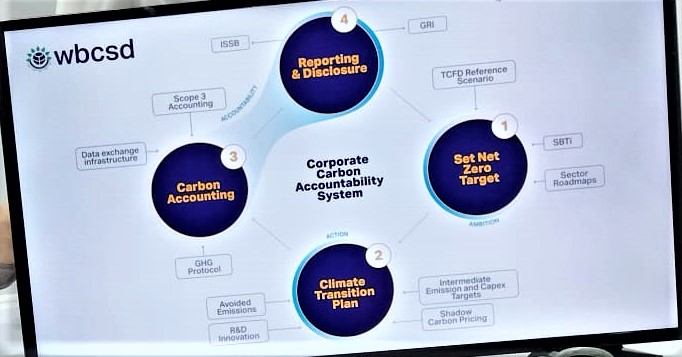
Accountability of Carbon neutrality pledges by the private sector

A carbon neutrality pledge is generally aimed at some future date like 2040 or 50 or beyond. This must be backed by an action plan with short term milestones that clearly show the path to be followed. Then standard protocols must be established for carbon accounting - not limited just to direct use of electricity and fossil fuels (what are called Scope 1 and Scope 2 emissions) but also accounting for the indirect emissions from actions such as sourcing of raw materials, construction and maintenance of infrastructure, managing waste on a daily basis and at the end of life of products, contracted out services, etc. (all of these are collectively called Scope 3 emissions). Current carbon accounting standards do not insist on Scope 3 accounting in spite of the fact that for many private sector entities this is the biggest contributor to their carbon footprint. And finally transparent and honest disclosure of the data is also important. 

All of this resonated very well with me because I have been saying more or less the same things for a few years. After Paris Agreement and the 1.5 deg C report by UNFCCC I felt that beyond investing in renewable energy infrastructure etc., the governments will have to eventually demand lowering of emissions by the private sector and might start including such pledges in the NDC. In that case it might become mandatory for companies to report their carbon emissions periodically. To an extent this has started appearing in NDcs from Europe. India cannot be far behind. 

I also felt that as more and more NGOs and institutions engage with the climate change issue, they should 'walk the talk' by going for low carbon operations and presenting the evidence to the world in a transparent way. 

Converting this thinking into action, we conducted a carbon accounting exercise for the headquarters of Laya, the secretariat of INECC. We have also tried to estimate the carbon emissions of some of our meetings and have tried to keep these as low as practically feasible. A few years ago, we launched a participatory process for educational institutions to go for carbon neutrality as a joint project by students, teachers and management, with our role as that of a mentor rather than a consultant. 

However, I could also see that in India we don't have enough people with even a basic understanding of what carbon accounting is - let alone be qualified carbon accountants and auditors. We need to build this basic understanding if carbon accounting is going to be a mainstreamed process in industry, academia and civil society. So, I launched an online course with the limited aim of building 'literacy' about carbon accounting around 2016. 

I in fact thought even beyond the accountability concerns that the panelists talked about. The IPCC Assessment Report 6 clearly stated that even stopping emissions is no longer going to be enough to meet the 1.5 deg C goal of the Paris Agreement. We have to also invest in removal of carbon dioxide from the atmosphere. Currently the only way to do that is to increase the land cover under natural ecosystems to sink the carbon into vegetation. Many of the carbon neutrality pledges are relying on creating carbon sinks. How does one account for that? I feel that the carbon accounting protocols need to include a component to estimate the 'sunk carbon' too. I have tried to include a flavour of that approach in my course. 

We ran the carbon accounting course in a rather amateurish and low-key manner for the past 5-6 years and then COVID happened. It has certainly opened my eyes to the various tools available and possibilities around online education. The course is currently being revamped in collaboration with 'Climatora'. Stay connected with Samuchit Enviro Tech on social media to know more about this! 

In the meanwhile, you can try our personal carbon footprint calculator in its new and revamped version made in collaboration with Climatora on this link.


Priyadarshini Karve
Director, Samuchit Enviro Tech
Convener, Indian Network on Ethics and Climate Change. 

Wednesday, August 11, 2021

Chatusutra_Loksatta_02: Battle of India's Survival

 Since January 2021, I am writing on Environment and Science in the 'Chatusutra' weekly column of Loksatta, a Marathi language newspaper. This weekly series contains four different themes being written by four different authors in a four-week cycle. My first article was published on the second Wednesday of the year, and thereafter my articles are coming every four weeks. One of the request from the readers has been to provide English translations for those who are not able to read Marathi. Meera Rotti took on the task to do this, and therefore I am launching this monthly mini-series. Every month, I will post the English translation of one article in the same chronological order that the Marathi articles have been published in Loksatta. 

Link to previous post: SUSTAINable Life: Chatusutra_Loksatta_01: Is Human A Virus? (samuchitenvirotech.blogspot.com)


02. Battle of India's Survival

The original Marathi article published on 10 Feb 2021 can be found HERE.  


On 20th January, 2021 Joseph Biden took charge as President of the USA, and on his very first day of work he initiated the process of bringing the USA back into Paris Agreement. The treaty adopted by 196 parties in the global conference on climate change that was convened by the UN in Paris in 2015 is known as the “Paris Agreement”. The USA, under the leadership of Barack Obama and Joe Biden, had played an instrumental role in negotiating the terms of this treaty. Obama's successor Donald Trump, whose win in 2016 was quite unexpected, was part of the climate denier community in the USA, and soon withdrew the USA from the pact. The new president Joe Biden has taken a number of strategically important policy decisions for climate change mitigation within first 10 days of assuming the office. This clearly indicates that bringing the USA back into Paris agreement is not just a token move in global politics.

Although the Paris agreement was signed in 2015, it officially comes into force from this year. Participation of the USA in this treaty is crucial for achieving the targets agreed in the pact.

Climate Change Crisis emerged over the course of industrialization driven by fossil fuels. Developed countries that have utilized the fossil fuels without any restraint over the last 150 years, and the countries which mine these fuels bear the maximum responsibility for creation of the global crisis. Though the industrial revolution originated in Europe, the USA accelerated its pace to the peak in the 20th century, and is also amongst the key producers of petroleum and coal. Though today it has been outpaced by China in industrialization, it still remains the second highest contributor to climate change. If the European union along with UK is considered as a single entity, then they are the 3rd and India is the 4th highest contributor to this crisis at present.

If the key problem creators are not involved in the process of resolving a problem, the chances of resolution fade away. This is exactly what happened in the case of the Kyoto Protocol of 1997. This Protocol obligated 37 developed countries to reduce their contribution to climate change to safeguard the world from an impending crisis. However, when it came to actual adoption of this protocol the USA revoked their decision of commitment, and subsequently none of the parties delivered on their agreed terms. Failure of this deal necessitated another pact.

The global crisis that seemed as a lurking problem in the late 1990s has now struck us with conspicuous signs. If the annual volume of fossil fuels, which continues its trajectory upwards, does not start to decline over the next 10 years, we will have to face catastrophic climatic changes at the end of this century. This precarious situation compels all the nations - whether among the primary contributors to climate change, or not - to be party to the Paris agreement.

China, EU and India showed a positive attitude towards the Paris Agreement; however, the sudden withdrawal of the USA had left them in the lurch. In that sense, existence of the entire human civilization was at stake in the 2020 presidential elections of the USA. Defeat of Trump has made wise people all over the world heave a sigh of relief.

These events are indeed positive from India’s perspective, and at the same time add to our responsibility. While India is one of the top 5 current contributors to climate change, it also ranks amongst the first 10 countries most vulnerable to the crisis. No other country faces this kind of a conundrum.

As a part of enforcement of the Paris agreement, India has been mainly focused on increasing the share of renewable energy in electricity generation. The efforts are on track towards the set target; however, according to some experts, the target itself is set considerably below the capacity and scope. Expanding the forest cover is also one of the commitments by India under the Paris Agreement. Misleading calculations by including agroforestry and fruit orchards under forest cover are being used to create an impression of the target being reached. However, in reality this is not going to achieve the desired end result as long as encroachment and destruction of natural habitats continues relentlessly leading to shrinkage of the true forest cover.

India has a vast coastal belt which is home to nearly 40% of its population. Sea-level rise induced by global warming is going to affect this population. The northern perennial rivers, which have enabled our food security, originate in the Himalayas. Global warming is causing melting of the glaciers, which are the origin of these rivers. Due to this, by the time the much-touted river-linking project is completed, the rivers in the North India will run dry, rather than having excess water to transfer to the southern drought-prone river basins. Climate change has led to an increase in the intensity as well as frequency of disasters like hurricanes, locust-attacks, forest fires etc. Weather-cycle too has altered. Excessive rainfall events are happening more often, and the dry spell between them is also increasing. Adverse effects of these are seen on agricultural and industrial activities as well as on cities and towns. Intensity of such events is only going to increase in the upcoming years which can severely damage the economic, social and political systems of India.

The wrath of the climate change impacts will have to be faced primarily by farmers, fishermen, tribals, daily wagers as well as the disabled, women, elderly, and children across all sections of the society. The situation experienced during the COVID-19 pandemic will be repeated during such circumstances. Those who created the problem - the urban rich (international travelers in the context of COVID, people with fossil energy driven lifestyle in the context of climate change) - will be able to protect themselves from such blows; however, those who had nothing to do with the problem will be the most vulnerable to a series of catastrophic impacts. This will result in a surge of helpless refugees.

What can we do today to avert this destructive future? Urban privileged citizens should introspect about their energy consumption. It is crucial to limit and optimize the use of energy, and also to use renewable energy as much as possible. The same principle applies to use of all resources and services as well. Furthermore, anticipating possible effects on the local ecosystem, and designing and implementing appropriate community-level emergency response systems can prove extremely beneficial. Nevertheless, only individual and community efforts cannot mitigate climate change crisis. These must be actively supplemented by science based and prudent policies.

Unfortunately, government policies are not shaped by recommendations from scientists. They are largely influenced by voters’ aspirations, or extreme pressure from either big business interests or international community. India’s climate action policies are largely shaped by the pressure of international politics. Safeguarding weaker sections of the society from the adverse impacts of climate change has never been high up on the global political agenda, and so is the case with India’s climate agenda. Most of the Indians are not even aware of the intensity and scope of the problems arising from Climate Change coming our way. As a result, they are also not vocal about it.

Shifting away from destructive policies chasing delusional developmental dreams cannot be expected from a political system that is at the mercy of oil, coal, and construction businesses. Public pressure is indeed crucial in bringing about the change. From this perspective, creating awareness among the adult citizens - the voters of today - is extremely necessary. Those who understand the gravity of the problems should persistently follow up with the representatives from local to national government bodies for changes in policy-making. This is the true battle we need to fight for India’s survival.


Author: Priyadarshini Karve

English Translation: Meera Rotti