#COP27: Day 5
11 November was the BIG high security day with the US President Joe Biden coming to the COP stage. Given USA's track record with the UNFCCC process, the US presence at COPs should be protested as much as the presence of fossil fuel industry at COP is protested! But unfortunately, politics trumps ethical considerations in this case.
If the Kyoto agreement had actually been delivered by the developed world, we would not be in the mess that we are currently in. The most important factor that weakened the Kyoto agreement was USA, the biggest emitter of greenhouse gases, walking out of the treaty.
The successor to Kyoto agreement was to be structured by 2010 and should have been ready to be implemented by 2015 if not 2012 (the end date for Kyoto agreement). This process was stalled by President Obama. This delayed the formulation of Paris agreement to 2015 and then its implementation to 2022 - nearly 10 years delay during which the earth continued to heat up.
In 2016 President Donald Trump pulled USA out of the Paris Agreement and almost derailed the second and perhaps the last chance that humanity had to avoid or at least contain a civilizational collapse.
President Biden brought USA back into the Paris Agreement as one of his first actions on getting elected. He has in the two years of his regime enacted certain measures that are likely to reduce USA's emissions by about 40%. But all this is too little too less. And the question remains - what happens if in 2024 USA gets a Republican president?
In spite of these uncertainties and past disappointments the world has no option but to continue hoping for more meaningful action from USA and applauding whatever little is thrown our way because of its political and economic clout across the world.
I stayed away from all the hoopla around President Biden's visit and address at COP which I am sure has already been reported by the press. Instead, I attended a very relevant discussion organised in the SDG pavilion by Council on Energy, Environment and Water (CEEW) and collaborators. This discussion was about accountability.
Big political leaders make lofty announcements at COP. Big businesses were racing against each other to announce carbon neutrality targets in last year's COP at Glasgow. Big Multilateral Development Banks make big promises of finance for low carbon and climate adaptive infrastructure in every COP. But there is no standard mechanism or process to check what is happening around these claims in an objective way. Where is the accountability? How do we build a structure that will infuse accountability in climate action? How to get reliable data that will allow third party assessment of the claims? That was the focus of this discussion.
For private businesses the carbon accounting process is one concrete way by which fulfilment of promises of carbon neutrality can be checked. For me the most interesting slide was what I show in the photograph below.
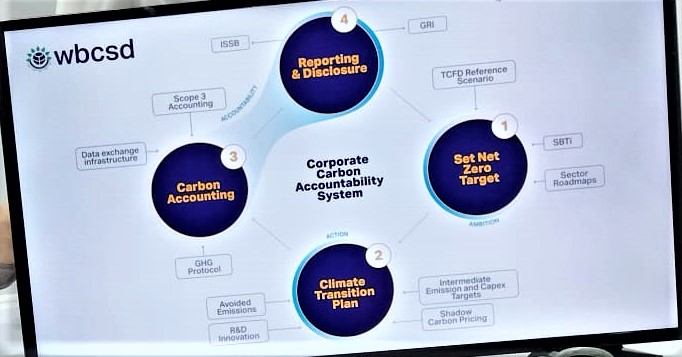 |
| Accountability of Carbon neutrality pledges by the private sector |
A carbon neutrality pledge is generally aimed at some future date like 2040 or 50 or beyond. This must be backed by an action plan with short term milestones that clearly show the path to be followed. Then standard protocols must be established for carbon accounting - not limited just to direct use of electricity and fossil fuels (what are called Scope 1 and Scope 2 emissions) but also accounting for the indirect emissions from actions such as sourcing of raw materials, construction and maintenance of infrastructure, managing waste on a daily basis and at the end of life of products, contracted out services, etc. (all of these are collectively called Scope 3 emissions). Current carbon accounting standards do not insist on Scope 3 accounting in spite of the fact that for many private sector entities this is the biggest contributor to their carbon footprint. And finally transparent and honest disclosure of the data is also important.
All of this resonated very well with me because I have been saying more or less the same things for a few years. After Paris Agreement and the 1.5 deg C report by UNFCCC I felt that beyond investing in renewable energy infrastructure etc., the governments will have to eventually demand lowering of emissions by the private sector and might start including such pledges in the NDC. In that case it might become mandatory for companies to report their carbon emissions periodically. To an extent this has started appearing in NDcs from Europe. India cannot be far behind.
I also felt that as more and more NGOs and institutions engage with the climate change issue, they should 'walk the talk' by going for low carbon operations and presenting the evidence to the world in a transparent way.
Converting this thinking into action, we conducted a carbon accounting exercise for the headquarters of Laya, the secretariat of INECC. We have also tried to estimate the carbon emissions of some of our meetings and have tried to keep these as low as practically feasible. A few years ago, we launched a participatory process for educational institutions to go for carbon neutrality as a joint project by students, teachers and management, with our role as that of a mentor rather than a consultant.
However, I could also see that in India we don't have enough people with even a basic understanding of what carbon accounting is - let alone be qualified carbon accountants and auditors. We need to build this basic understanding if carbon accounting is going to be a mainstreamed process in industry, academia and civil society. So, I launched an online course with the limited aim of building 'literacy' about carbon accounting around 2016.
I in fact thought even beyond the accountability concerns that the panelists talked about. The IPCC Assessment Report 6 clearly stated that even stopping emissions is no longer going to be enough to meet the 1.5 deg C goal of the Paris Agreement. We have to also invest in removal of carbon dioxide from the atmosphere. Currently the only way to do that is to increase the land cover under natural ecosystems to sink the carbon into vegetation. Many of the carbon neutrality pledges are relying on creating carbon sinks. How does one account for that? I feel that the carbon accounting protocols need to include a component to estimate the 'sunk carbon' too. I have tried to include a flavour of that approach in my course.
We ran the carbon accounting course in a rather amateurish and low-key manner for the past 5-6 years and then COVID happened. It has certainly opened my eyes to the various tools available and possibilities around online education. The course is currently being revamped in collaboration with 'Climatora'. Stay connected with Samuchit Enviro Tech on social media to know more about this!
In the meanwhile, you can try our personal carbon footprint calculator in its new and revamped version made in collaboration with Climatora on this link.
Director, Samuchit Enviro Tech
Convener, Indian Network on Ethics and Climate Change.


