Showing posts with label accountability. Show all posts

Thursday, November 17, 2022

Firsthand experience at the COP27 Egypt

Hello people, 

Being a local from Pune and working along with grassroot initiatives gives me a feeling of immense pleasure and satisfaction. But when you get a chance to talk about the initiatives with people at a global platform it’s the next level feeling.

The 27th Conference of Parties (COP) is one of the most expensive ones happening post covid. It is partly as a recovery from the pandemic and partly because the host city is a resort city. One may feel why organize such large scale meetings and consultations? Why to add to the already increasing emissions pool?

Trust me this global meeting is very much needed from accountability perspective. It’s a platform where NGOs, Activists, Youth, Civil Society Members like you and me get an opportunity to hold the Head of the States, Ministers and Negotiators our leaders responsible for their actions at an international level. This platform has a legal binding so if that is a fight it is to be fought here.

Entrance banner

Now that all the carbon emissions happening due to the meeting with all the flights coming in and with all the resources that are being pulled in for this annual meeting are being optimized but there's still a lot of scope.

So far, this year’s COP has been disappointing from Climate Finance perspective since so far only a few million dollars have been poured in by the emitters when what we need is billions of dollars for all the loss and damage that has already been occurred. There are a lot of ‘Ifs and Buts’ on how to fund and whom to fund...blah blah blah.

But with whatever sessions I attended and with all the work that we are doing at INECC, LAYA and Samuchit I am quite hopeful, and this COP added value to my HOPE. The work that is happening at local level has immense potential to take on the whole world without the petty finance from these historic emitters or the so-called developed nations. Nevertheless, from justice point of view it is their moral and legal responsibility to fund their fellow people on this planet. That too in the form of absolute fund and not in debt, this point was raised very clearly in one of the sessions that I attended. Climate crisis is indeed a human rights issue and it’s our right to ask for all that is lost and damaged with or without the political will. Our environment and surroundings are not dependent on us, we humans are dependent on them. Our world leaders have to realize they are on a suicidal pathway. If they don't, it's time for us to change our leaders who can turn the tide! That's where our work with engaging citizens and youth gets crucial. 

Side event on Global Goal on Adaptation by CAN 

Nevertheless, this COP also gives me HOPE, to see so many developing countries, indigenous groups and even a war struck nation like Ukraine making a point to come here on a global platform and put forth their perspective. Though some are playing a victim card, but they are here to show that we need to be heard and that is important. A lot of Adaptation and Climate Finance has already been diverted towards pandemic and wars. Hence it is important now to create an additional pool of resources for such uncertainties and fund the ones who are part of the solution ensuring to make this world a better place to live in.

Ukraine Pavillion at the COP27

Asia Pacific Youth group


I was all excited and overwhelmed with everything happening around in this meeting. Right from getting into the registration hall with all the security therein.  Then setting our booth space and meeting online friends from Asia Pacific Youth group and so on. It was so good to see all group members face to face. Seeing the energy and enthusiasm of my young fellas from Australia, Japan, Philippines, Malaysia, Bangladesh, Indonesia and India gave a lot of HOPE for a better future!!!

We also had our side event, for which I was nervous for no reason. I was not on the panel, still with all the stalwarts on the panel, our side event went quite well and well in time too. Hats off to my colleagues on the panel Myron Mendes, Nakul Sharma and Martin Voss and our moderator cum opener Dr Priyadarshini Karve for a great show. It gives me a feeling of pride to be part of the team.

Our side event at the COP27 on the big screen

The best part this year’s COP events focused on local solutions and actions on ground as well. INECC’s initiative on Locally Developed Choices for Nationally determined Contributions (LDC for NDC) was first such side event to be showcased! I realized later that a lot of organizations are working on local solutions and had the same opinion as us. Thus, we were all showing solidarity in the work that is being done for making ourselves Climate resilient.   

COP27 Side events schedule

Being part of local campaigns and undertaking social media campaigns is something that I feel is required, but the way it is done matters. I am glad that I could participate in one such campaign on asking the emitter nations to ‘Pay Up 4 Loss and Damage’ at an international level organized by Climate Action Network (CAN). The best part was when a pack of Ministers passed by the whole campaign gained momentum and everyone there looked upon them for paying up to the climate crisis. There were around 500+ people there in all, young and old, supporting the campaign at that time. It was quite a scene!  

Me at the CAN campaign
Another interesting campaign by CAN was on awarding the Fossil of the Day award to entities that are doing their best at their worst like supporting fossil fuels. It’s all about holding these 'villains' responsible for their actions. There were some other campaigns such as endorsing ‘Non-Proliferation of Fossil Fuel treaty’, conserving Oceans, saving vulnerable communities, etc. Apart from this there were many interesting discussions and sessions happening at the same time in multiple pavilions, it was very difficult to decide which one to attend. How to get to that place was another exercise altogether, the overall logistic arrangement in this COP was horrible, from the chaotic shuttle service to the maps provided everywhere making no sense... but we still managed to get to places.

Campaign on Ending Fossil Fuel at COP27
  

With all the e-networking that I had been into since the past couple of years, I happened to meet all these people here. I met my Bangladeshi friend Zuhair from the Conference of Youth (COY) I attended in 2017, one of the mentors from my Education for Sustainable Development (ESD) coursework Raji working in Andhra Pradesh was happy to see me and know that I am working with LAYA that is situated in Vizag. Also met fellow Climate Reality member Rituraj Phukan who's doing great work on ground in Assam on Climate Education.

Face to Face meetups at the COP27

Also made new connects with groups working on similar initiatives from other South Asian countries like Bangladesh and met people from INFORSE a very active network having a consortium of developed plus developing country organizations working on sustainable energy access. Attended a session by CEEW whose work we follow at the SDG pavilion. We also met old friends of Nafisa and Dominic who have attended almost every COP and are still excited about COP and are still exploring ways to participate in the campaigns. 

INFORSE meet at their booth in COP27

The one week at COP has been very enriching for me and I am grateful for attending this one!!!

Pournima Agarkar. 


You can connect with us on Facebook, Instagram and Twitter 

OR message here to join our WA group.  

www.samuchit.com
https://inecc.net/
https://www.laya.org.in/


Saturday, November 12, 2022

Musings from Priyadarshini Karve: #COP27: Day 5

 #COP27: Day 5

11 November was the BIG high security day with the US President Joe Biden coming to the COP stage. Given USA's track record with the UNFCCC process, the US presence at COPs should be protested as much as the presence of fossil fuel industry at COP is protested! But unfortunately, politics trumps ethical considerations in this case. 

If the Kyoto agreement had actually been delivered by the developed world, we would not be in the mess that we are currently in. The most important factor that weakened the Kyoto agreement was USA, the biggest emitter of greenhouse gases, walking out of the treaty. 

The successor to Kyoto agreement was to be structured by 2010 and should have been ready to be implemented by 2015 if not 2012 (the end date for Kyoto agreement). This process was stalled by President Obama. This delayed the formulation of Paris agreement to 2015 and then its implementation to 2022 - nearly 10 years delay during which the earth continued to heat up. 

In 2016 President Donald Trump pulled USA out of the Paris Agreement and almost derailed the second and perhaps the last chance that humanity had to avoid or at least contain a civilizational collapse. 

President Biden brought USA back into the Paris Agreement as one of his first actions on getting elected. He has in the two years of his regime enacted certain measures that are likely to reduce USA's emissions by about 40%. But all this is too little too less. And the question remains - what happens if in 2024 USA gets a Republican president? 

In spite of these uncertainties and past disappointments the world has no option but to continue hoping for more meaningful action from USA and applauding whatever little is thrown our way because of its political and economic clout across the world. 

I stayed away from all the hoopla around President Biden's visit and address at COP which I am sure has already been reported by the press. Instead, I attended a very relevant discussion organised in the SDG pavilion by Council on Energy, Environment and Water (CEEW) and collaborators. This discussion was about accountability. 

Big political leaders make lofty announcements at COP. Big businesses were racing against each other to announce carbon neutrality targets in last year's COP at Glasgow. Big Multilateral Development Banks make big promises of finance for low carbon and climate adaptive infrastructure in every COP. But there is no standard mechanism or process to check what is happening around these claims in an objective way. Where is the accountability? How do we build a structure that will infuse accountability in climate action? How to get reliable data that will allow third party assessment of the claims? That was the focus of this discussion. 

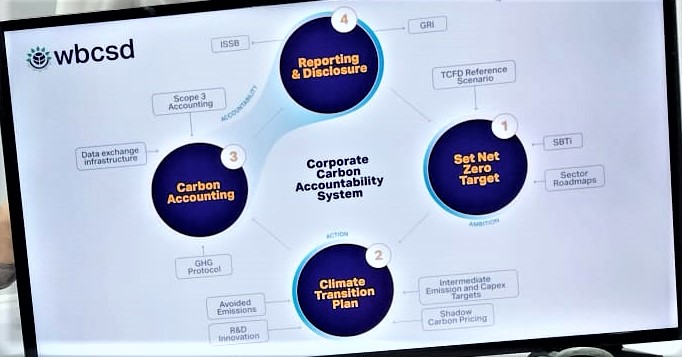
For private businesses the carbon accounting process is one concrete way by which fulfilment of promises of carbon neutrality can be checked. For me the most interesting slide was what I show in the photograph below. 

Accountability of Carbon neutrality pledges by the private sector

A carbon neutrality pledge is generally aimed at some future date like 2040 or 50 or beyond. This must be backed by an action plan with short term milestones that clearly show the path to be followed. Then standard protocols must be established for carbon accounting - not limited just to direct use of electricity and fossil fuels (what are called Scope 1 and Scope 2 emissions) but also accounting for the indirect emissions from actions such as sourcing of raw materials, construction and maintenance of infrastructure, managing waste on a daily basis and at the end of life of products, contracted out services, etc. (all of these are collectively called Scope 3 emissions). Current carbon accounting standards do not insist on Scope 3 accounting in spite of the fact that for many private sector entities this is the biggest contributor to their carbon footprint. And finally transparent and honest disclosure of the data is also important. 

All of this resonated very well with me because I have been saying more or less the same things for a few years. After Paris Agreement and the 1.5 deg C report by UNFCCC I felt that beyond investing in renewable energy infrastructure etc., the governments will have to eventually demand lowering of emissions by the private sector and might start including such pledges in the NDC. In that case it might become mandatory for companies to report their carbon emissions periodically. To an extent this has started appearing in NDcs from Europe. India cannot be far behind. 

I also felt that as more and more NGOs and institutions engage with the climate change issue, they should 'walk the talk' by going for low carbon operations and presenting the evidence to the world in a transparent way. 

Converting this thinking into action, we conducted a carbon accounting exercise for the headquarters of Laya, the secretariat of INECC. We have also tried to estimate the carbon emissions of some of our meetings and have tried to keep these as low as practically feasible. A few years ago, we launched a participatory process for educational institutions to go for carbon neutrality as a joint project by students, teachers and management, with our role as that of a mentor rather than a consultant. 

However, I could also see that in India we don't have enough people with even a basic understanding of what carbon accounting is - let alone be qualified carbon accountants and auditors. We need to build this basic understanding if carbon accounting is going to be a mainstreamed process in industry, academia and civil society. So, I launched an online course with the limited aim of building 'literacy' about carbon accounting around 2016. 

I in fact thought even beyond the accountability concerns that the panelists talked about. The IPCC Assessment Report 6 clearly stated that even stopping emissions is no longer going to be enough to meet the 1.5 deg C goal of the Paris Agreement. We have to also invest in removal of carbon dioxide from the atmosphere. Currently the only way to do that is to increase the land cover under natural ecosystems to sink the carbon into vegetation. Many of the carbon neutrality pledges are relying on creating carbon sinks. How does one account for that? I feel that the carbon accounting protocols need to include a component to estimate the 'sunk carbon' too. I have tried to include a flavour of that approach in my course. 

We ran the carbon accounting course in a rather amateurish and low-key manner for the past 5-6 years and then COVID happened. It has certainly opened my eyes to the various tools available and possibilities around online education. The course is currently being revamped in collaboration with 'Climatora'. Stay connected with Samuchit Enviro Tech on social media to know more about this! 

In the meanwhile, you can try our personal carbon footprint calculator in its new and revamped version made in collaboration with Climatora on this link.


Priyadarshini Karve
Director, Samuchit Enviro Tech
Convener, Indian Network on Ethics and Climate Change. 

Wednesday, April 3, 2019

My City My Responsibility - Participatory Planning and Management

Dear All, 

Participation and Integrated planning & Management
Last year, we collected a few citizens' perspectives on certain issues related to Urban Sustainability. These included Housing, Transport, Governance or Peoples Participation, Heritage (both Cultural and Natural), Waste management and Air pollution, Disaster Risk Assessment and Green Open Spaces. For relating it to a broader vision, we used the Sustainable Development Goals (SDGs) framework especially the SDG 11 which deals with making cities and settlements sustainable. We compiled all citizens inputs and formed the Citizens Charter for Sustainable Pune. In our event on Citizens Charter and Action Agenda for Sustainable Pune we shared the same document with all of you. On analyzing all the Citizen inputs, we realized that if these inputs are put up as actionable points it will be a good guideline to follow by all.

So far we have seen targets related to Housing and Transport under SDG 11. The next target is all about having participatory, integrated and sustainable planning and management of human settlements. 

In the city planning and management, participatory approach is easier SAID than DONE. I feel there is a need to define 'inclusive participation' so as to ensure participation from all the strata of the society. However only a few people get the privilege to participate in any decision making, planning process and management. During our survey we found that there is something called as participatory budget, however very few people are aware of such an initiative. This is also due to lack of empathy among citizens towards their city's overall growth. However, its time we start getting aware of our surroundings and make ourselves sustainable.

Lets us see what the citizens have to say about their participation in the overall planning and management of the city.

Individual Level: 

  • Be aware of your rights and duties as a citizen of the city.
  • Use RTI as a tool for enabling the rights of a citizen.
  • Participate in the city's planning and management systems.
  • Check if we have any ward level meetings in our ward. 
  • Need for empathy towards our society. 

Community Level: 

  • Mohalla committee's are good examples of community participation, more and more people should involve themselves in this system for ensuring their area development. 
  • Lets understand the functioning of similar systems like area sabhas and advocate for the same. 
  • Lets keep track of upcoming policies and schemes and how they affect our area 
  • Lets raise voice in case of poor provision of basic service in your area and work cohesively with the local bodies in order to ensure services are in place.

Governance Level: 
  • Ensure use of scientific sampling techniques for collecting feedback proactively from a well chosen sample cross section of the city's society on various schemes and policies (rather than expecting people from all strata of society to respond to generic requests for comments). 
  • Involve local citizen groups, civil society organizations, Mohalla committee groups, Resident welfare associations, differently abled individuals etc. in governance-focused public discussions to make governance inclusive. 
  • Need to have an active feedback mechanism in order to track success and failure of any policy. 
  • Need to have a mechanism to reward or highlight community best practices that ensure success of any scheme or policy. 
  • Enforce wardwise community meetings ensuring involvement of all irrespective of caste, creed, gender or income level. 
  • Ensure transparency and accessibility of information to all in existing/current schemes/policies on urban development.

These are a few key inputs given by 200 odd people, we are looking for more such inputs and suggestions from you in order to make our Citizens Charter a better Action Agenda. 
Email me at pournima@samuchit.com OR like, share and comment on our FB page  @ https://www.facebook.com/SustainableCityPune/

Pournima Agarkar.

Friday, April 3, 2015

If we save the earth, the earth will save us back!

If we save the earth, the earth will save us back!


    Samuchit Enviro Tech.     samuchit@samuchit.com     www.samuchit.com