Showing posts with label mitigation. Show all posts

Monday, November 14, 2022

Musings from Priyadarshini Karve: #COP27: Day 6

 #COP27: Day 6

Saturday November 12 was our last day at COP27. The meeting also takes a break on Sunday and will continue for another week. But our stay here is over. 

As I mentioned in one of the previous blogs, Egypt and Sherm al Sheikh have not done a great job with the logistics of the conference. 

It was not clear till about two weeks before the start of the conference whether we would even be able to be here. The hotels all over the city were arbitrarily hiking prices and refusing to confirm reservations. We managed to sort out our stay arrangements and were able to absorb the escalated cost, but many other people from NGO sector had to cancel their trips. Several people were blackmailed into paying more after arrival here. 

For almost half of the first week the prices of food and beverages inside the venue of the conference were exhorbitantly high. After a lot of protest from the observer organisations the food prices were slashed by half. It seems that the hotels with bookings for the second week of the conference have also been told to lower their prices and not demand extra money from the participants. But all in all, it appeared that the hosts tried their best to contain the civil society presence at the COP. However, those of us who did get here and those who will come in the second week in spite of all the hurdles have certainly made our presence felt. There has been some protest or other going on almost daily and drawing a lot of media attention from around the world. 

Some of the newslinks are here and here and here.
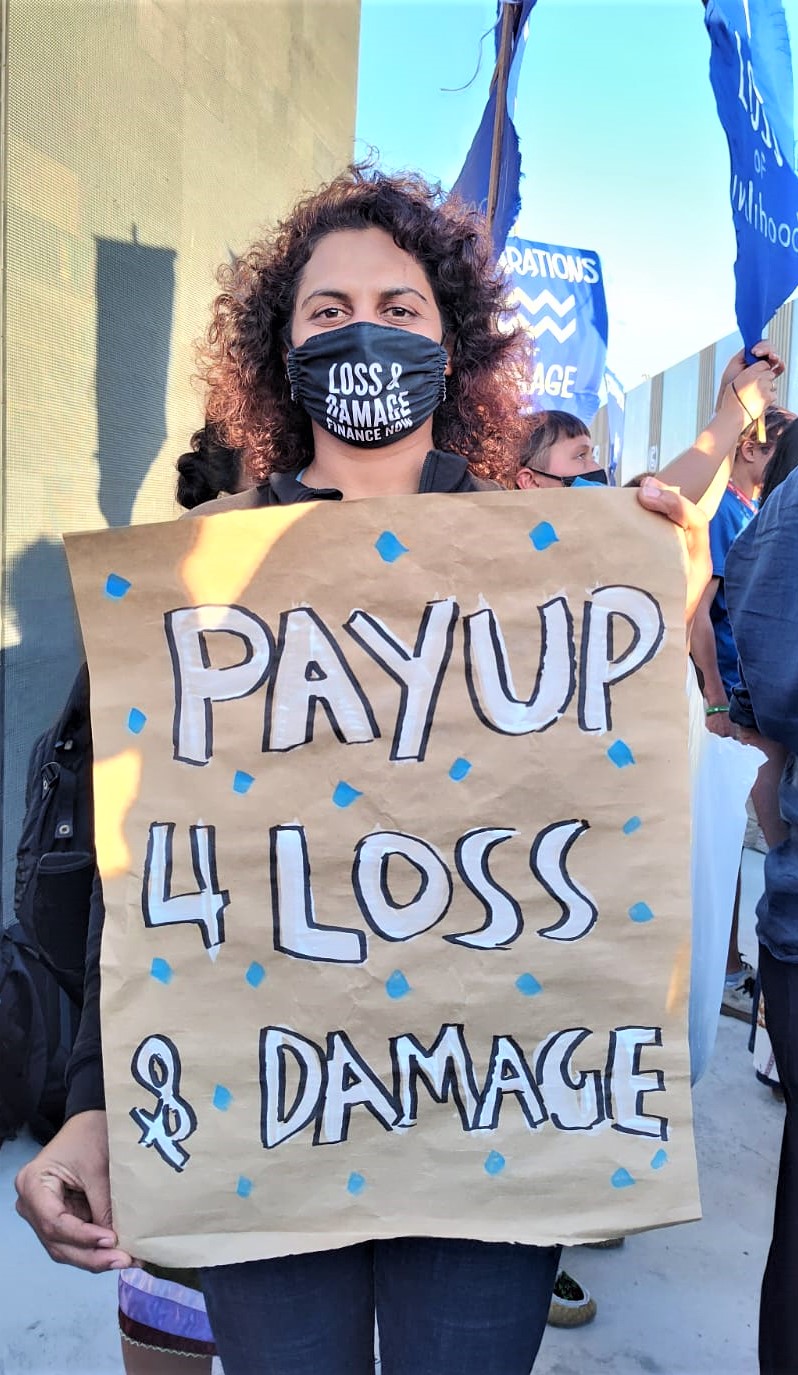
INECC team member Pournima in the Climate Action Network (CAN) Protest

On my last day at COP27, I attended what was for me the best side event. It was organised by International Network for Sustainable Energy (INFORSE) and had speakers from Europe, Africa and South Asia. It was interesting to see that organisations in Denmark on one hand and several prominent countries in Africa on the other hand have come up with systematic plans to shift to 100% renewable energy with a clear timeline. The plans presented were very much grounded in practicality and focused on solar - wind - hydro and sustainable biomass energy with each country focusing on its own unique combination. The south Asian presenters were from India, Bangladesh, Nepal and Sri Lanka. They too presented how localised renewable energy solutions that are helping local communities to achieve climate adaptation as well as contribute to mitigation. This was exactly the pathway that we too are pushing for through our #LDCforNDC campaign. 

Personally, it was heartening to see that in spite of the big push and bad mouthing of biomass fuelled cooking by LPG and electricity lobby, the grassroots level organisations in Africa and South Asia still see the importance of improved cook stoves and biogas plants based on waste biomass as the more realistic solutions for meeting cooking energy needs. They also had practical data on how these humble interventions support both adaptation and mitigation. 

What I liked the most about this side event was that all the presentations were to the point, matter-of-fact showcasing of solutions without dwelling much on 'victim' status of the communities. 

Another observation that was personally important to me - I saw on the stage several individuals and organisations that I had connected with at some point or other in the last 22 years of my professional career! I was really happy to see that all of us are still continuing to fight the 'good fight' in our own spheres of influence! I will surely be re-connecting with all of them in the near future and will explore what more we can do collectively. 

On this positive note I am now ending this series of blogs from COP27. Thank you all of those who read and encouraged me to keep this going! 

Climate Action must go hand in hand with SDGs to achieve climate justice

Day 5 Blog

Day 4 Blog

Day 3 Blog

Day 2 Blog

Day 1 Blog


Priyadarshini Karve
Director, Samuchit Enviro Tech
Convener, Indian Network on Ethics and Climate Change (INECC)

Thursday, November 10, 2022

Musings from Priyadarshini Karve: #COP27: Day 3

 #COP27: Day 3


9 November 2022 was officially 'Finance Day'. The negotiators discussed finance for mitigation, adaptation and also for 'loss and damage'. The side events of the day were also focused on the theme of finance. 

As we entered the venue we came across an interesting protest displaying a dinosaur and a Pokémon! A number of young activists were speaking on how climate change induced disasters are affecting their countries. The demand of this protest was 'Stop Funding Fossil Fuels'. 

Stop Funding Fossil Fuels! 

I attended two side events - both organised by members of Climate Action Network (CAN) and focused on 'Adaptation' and 'Loss and Damage'. 

I am going to digress a bit and try to explain these terms. 

When it comes to climate action, the media and public discourse is generally focused on 'Mitigation' - reducing greenhouse gas emissions going into the atmosphere. This is important for slowing down future warming of planet earth. This requires moving away from fossil fuel use and change our land use pattern. Most of the climate finance is currently focused on this aspect. 

However there is also 'Adaptation'. The planet is already about 1.1 deg C warmer than the preindustrial era. This has changed the weather patterns and ecosystems around the world permanently. People now have to change their ways and means of life in order to deal with the changes. Some of the challenges may be solved by behavioural change (for example - change the timing of outdoor work to deal with excessively hot summers) but some require use of technology (for example - rainwater harvesting and storage for better water security in spite of the erratic rainfall). Financing for adaptation has been a contentious issue at COPs for a long time. Developed countries have promised big money but actually provided very little. 

A third front on climate action now is 'Loss and Damage'. As global average temperature has creeped up over the last few decades, many communities across the globe are facing an existential crisis (for example - the Maldives will be totally submerged in a decade or so even if all GHG emissions drop to zero today). As sea levels rise, coastal communities lose their lands and homes and therefore their way of life, culture and traditions. They are getting uprooted and displaced. As certain parts of the world are repeatedly hit by cyclones, people are losing lives and livelihoods. For a long time, the developed countries have tried to argue that dealing with such situations also should be considered 'Adaptation' (and therefore no separate funding is needed for this). But the developing countries have strongly argued that 'Loss and Damage' is happening because both 'Mitigation' and 'Adaptation' are failing. Some countries need urgent help while we strengthen the efforts on Mitigation and Adaptation. Finally, this year financing for 'Loss and Damage' is being discussed. The news is that the countries have agreed to put in place a mechanism for this 'no later than 2024'. 

The first side event in the morning was by CANSA (CAN South Asia) of which INECC is a member. There were presentations from Nepal and Bangladesh talking about how localised and community-centric action with co-operation and collaboration of government is helping these two highly affected countries adapt better and thereby minimise loss and damage. This exactly resonated with our own 'LDC for NDC' concept. Both the presentations also strongly highlighted the importance of the support of government machinery from local to national for more effective adaptation at the local level. 

The final speaker of the event was a Minister from Pakistan. Pakistan is proving to be the showcase of 'Loss and Damage' in this COP. As the minister said - the country suffered an extremely hot summer followed by unprecedented and devastating floods during the monsoon season, and now it is entering what is likely to be an extremely cold winter! Climate change is really hammering them hard from all sides! It is no wonder therefore that the Pakistan pavilion has a caption 'Lost and Damaged' prominently on display. 

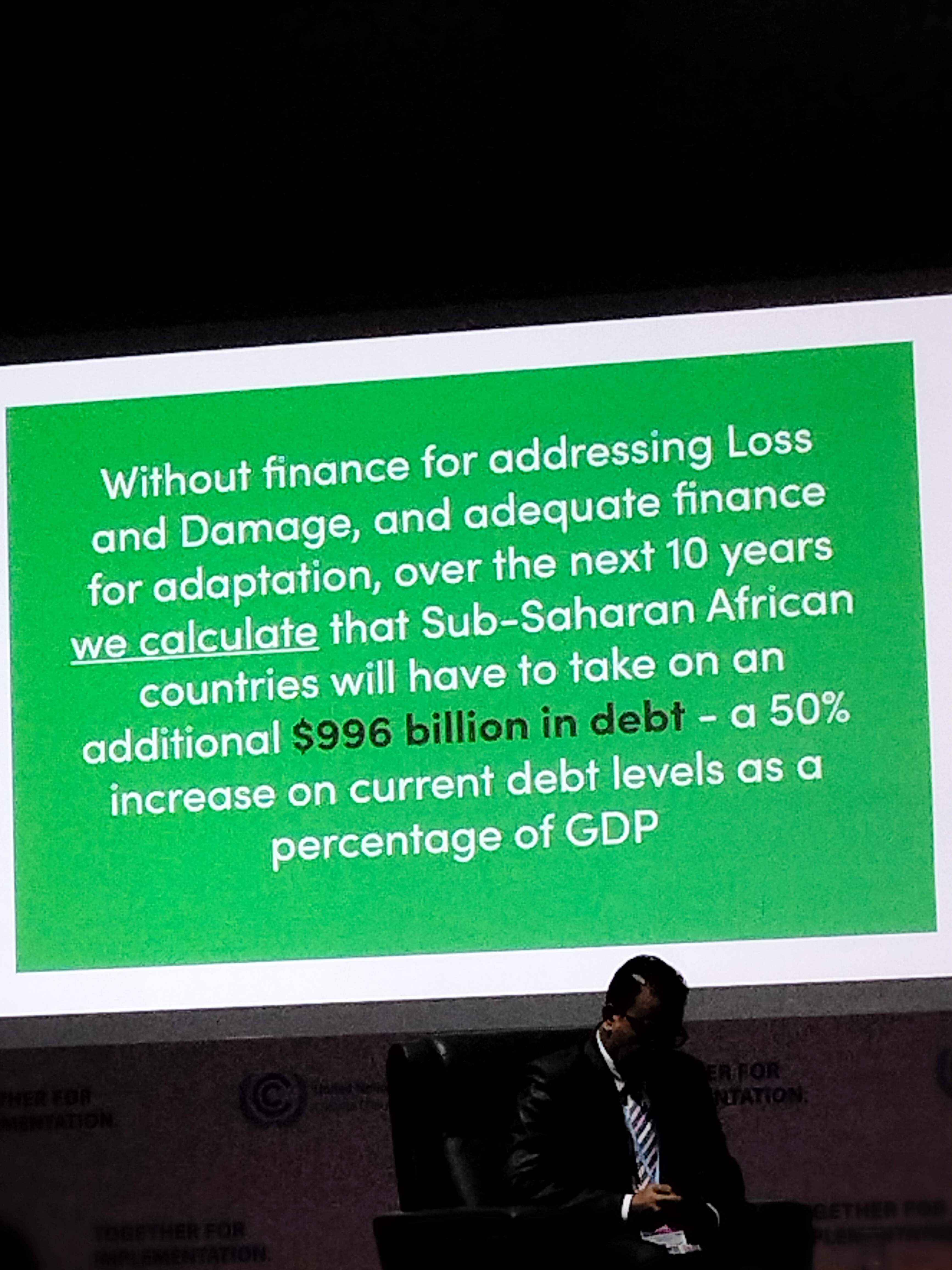
One important point that was made in this side event was around the nature of finance. Even though it is a moral obligation of the developed world to help the developing world deal with climate change, 70% of the climate finance available (of all categories) is in the form of debt and that too at very high interest rates! Strong arguments are therefore being made on all fronts that existing debts be written off and future finance not have a 'debt' component. One slide that presented eye opening statistics in this context is what you can see below. 

The Climate Debt Trap

The second side event was organised by CAN and a few collaborators. Its focus was 'Loss and Damage'. It had presentations from Malawi in Africa and Bangladesh. There were also presentations about how women are more affected than men when it comes to loss and damage. All in all there were very moving presentations starkly highlighting the plight of the vulnerable communities. One important point made was that while a lot of funding pours in for disaster relief when a tragedy strikes, not much finance is available for preventive or preparatory measures. It is hoped that the 'Loss and Damage' funding will address this gap. 

As my colleague Pournima pointed out - often in the discussion on loss and damage, the communities come across as helpless and clueless people doing nothing as disasters creep on them. But the ground reality is that communities can exhibit resilience and resourcefulness. They are not totally without any agency of their own! They of course need a helping hand - in the form of finance as well as in the form of knowledge and data. 

The loss and damage finance facility needs to focus on empowering communities to protect and rescue themselves in a sustainable way. Our 'LDC for NDC' process is showcasing some of the success stories of this approach. 


Day 2 Blog

Day 1 Blog


Priyadarshini Karve
Director, Samuchit Enviro Tech
Convener, Indian Network on Ethics and Climate Change (INECC)

Wednesday, November 9, 2022

Musings from Priyadarshini Karve: #COP27: Day 2

 #COP27: Day 2

8 November 2022, the second day of COP27, was an important day for our team. We were going to kick off the calendar of side events! 

While the UNFCCC COP is primarily about various government representatives negotiating the future of state-lead climate action across the world, the observer organisations attending the conference have their own calendar of events. In this COP we have been assigned a booth for 3 days and we were also allotted a slot for a side event. We had applied for a side event a few months ago, but we were waitlisted (many organisations are keen to have their say on the global platform, however there are space and time constraints). We were finally sanctioned a side event after we agreed to merge with another organisation. This happens a lot of the times and generally the collaborators try to present a single cohesive side event of 1.5 hr duration. Sometimes it does not work out that way - which was our case this time. 

We thus had 45 min to say our piece. As the moderator of the session I am happy to say that everything worked smoothly, the speakers stayed on schedule, and we managed to hand over the stage to the next moderator on the 44th minute. I feel rather proud of our team work and planning that made this work in an effortless manner. 

Laya Side Event COP27: 
From L to R: Nakul Sharma, Martin Voss, Myron Mendes, Priyadarshini Karve

So what was our side event about? 

We talked on 'Locally Developed Choices' for 'Nationally Determined Contributions' - LDC for NDC. This is INECC's current theme of action and we wanted to talk about it with the global audience. The gist of our argument is this: 

Paris Agreement is not just about keeping the warming below 1.5 deg C, it also talks about helping the climate-affected populations for adaptation. However, this aspect has always been ignored by the UN negotiators. This year finally the COP is looking at 'Loss and Damage' (more about this in a latter blog!) but the developing countries really had to struggle hard to get the topic on the discussion agenda. If one looks at the NDCs (commitments by individual national governments under Paris Agreement) these too only talk about mitigation. As a result, when climate change impacts hit locally, communities have to fend for themselves. This is however leading to some innovative choices being developed locally (LDC) that can not only achieve adaptation but also contribute to mitigation. For the last couple of years INECC has been trying to document such LDC and trying to build an awareness raising as well as policy advocacy campaign around these initiatives. 

Laya Side Event @ COP27:
Priyadarshini explaining '
LDC for NDC'
In the side event I explained the 'LDC for NDC' concept with the example of lacunae in India's NDC and also briefly described the work we have done so far on this theme. My colleague Myron Mendes presented the case study of Laya's work on resilience building among the indigenous communities in the Eastern Ghats through technology interventions in agriculture and basic services. Nakul Sharma of Climate Action Network South Asia (CANSA) presented a case study of local action for adaptation from Nepal which described a wonderful collaboration between local community groups and local government. The final speaker was Martin Voss of GermanWatch who talked about how the big multilateral banks can and should fund replication of such success stories... but unfortunately are still stuck in the conventional thinking of pouring money into big infrastructure projects. 

Even though we had 4 speakers and only 45 minutes, we had structured the session in such a way as to keep 10 minutes for questions and comments from the floor. And this turned out to be a very good decision! We had an audience of about 20-30 people. A member of the organisation leading the local action in Nepal was present in the audience and gave some additional detail on the case study presented by Nakul. The theme of LDC for NDC seemed to have really resonated with people from Africa in the audience. A couple of them made very moving comments on personal experiences of how the local reality is being ignored by the state-driven 'climate action'. One audience member pointed out the importance of understanding local vulnerabilities to shape adaptation - basically that funding for adaptation and resilience building must be targeted at ecosystem community level rather than at country level.  

All in all, I can say that we managed to get our point across. We felt highly encouraged by the reactions from the audience and hope to build an international momentum behind LDC for NDC! 

The side event was livestreamed and for those who are interested here is the link. We are in the first 45 min.  


Day 1 Blog


Priyadarshini Karve
Director, Samuchit Enviro Tech
Convener, Indian Network on Ethics and Climate Change (INECC)
Tuesday, September 10, 2019

MUSINGS FROM PRIYADARSHINI KARVE: One and Only Solution to Climate Change?

Image result for indian food plate


I have absolutely no problem with people wanting to go vegan or whatever other food preferences they want for themselves, based on any moral, ethical or whatever reasons of their own. 

I have serious concerns about promoting 'veganism'  (or any single lifestyle change for that matter) as THE ULTIMATE and UNIVERSAL solution of climate change. 


The earth and its atmosphere is a complex system - both scientifically and socio-economically. Climate change is a complex problem - both scientifically and socio-economically. Every human culture is playing a different role in this complexity, some aspects of which are positive and some are negative. Recognition of climate change as a universal problem to be tackled by everyone is one thing. Demanding that everyone should address the problem using the same and single strategy is an entirely different thing. We need an array of actions to tackle this complex problem. Moderation in access to all sorts of resources, including food, is indeed a common thread in most solutions, but the specifics of that moderation required of different cultures will obviously have to be different.

We generally develop simplified models to understand the complex geological-biological world around us. Often analysis of data based on simplified models suggests one thing, but reality is much more complex. Total abstinence and bans have never solved any social or environmental problem in the past. On the other hand, there are many instances of unexpected disasters caused by such measures. From that perspective too, I have serious reservations against any measure that talks about total exclusion of something or total ban on anything. 


There is also another aspect to this. Even in the Western world, where veganism and curbs on industrial agriculture (which includes animal husbandry) will indeed have a significant positive impact in terms of climate change, I think that the fashion of projecting veganism as THE ultimate climate change solution has potentially dangerous consequences. It is interesting that most vocal supporters of veganism in the West are the rich and famous who otherwise live a very energy intensive lifestyle. So are they going vegan to eliminate the feeling of guilt about their mansions and yachts and private jets? Will going vegan then justify ramping up everyone's personal use of fossil energy?

I repeat, the same problem exists with any single action being projected as the ONE and ONLY solution of climate change. For example, going totally off fossil fuelled transport can be a personal choice, but it becomes problematic if that is recommended as the one and only prescription for the entire world to address the problem of climate change! Will it then be ok if I went everywhere on a bicycle but lived in an airconditioned mansion and ate nothing but meat??


It is admirable and good to feel passionate about a cause and to promote it with enthusiasm. However, I sincerely request my vegan friends to not fall into the trap of finding 'the single ultimate truth'! Truth is always relative and comes in hundred shades of grey! Same is the case with solutions to climate change. 


Priyadarshini Karve
Director
Samuchit Enviro Tech


#BeModernBeResponsibleBeRespectful

   
Samuchit Enviro Tech.     samuchit@samuchit.com     www.samuchit.com 

Tuesday, February 12, 2019

My City My Responsibility - Climate friendly Garden waste management

Dear All, 

On last Thursday 7th Feb, 2019 we at Samuchit conducted a full day workshop on Climate Friendly management of Garden waste in Indradhanushya Environment and Citizenship Centre, Pune. I have been associated with Samuchit for the past two years now, however, this was the first time I participated in one of the core work areas of Samuchit related to waste management and climate change and I was super excited for the same.  

Though it was a full day workshop, Dr Karve, planned it in a very engaging, inclusive, detailed and free flowing manner giving ample time for questions and discussions. I am sure no one must have been exhausted at the end of the day except the speaker. 

Group Photo.
PC: Harshil R


In the first half part of the day, Dr Karve took us back to fifth grade science where she explained the carbon cycle that helps understand the critical phenomenon of Climate Change in a simple manner. She clarified a lot of myths around composting, burning and traditional/religious practices and explained the scientific reality. She also explained that garden wastes having higher generation rate and lower decomposition rate makes the management of this waste biomass more difficult. Even though burning of waste is prohibited, most housekeepers or helpers tend to burn this biomass in open air, creating a lot of local pollution.

Here, Samuchit's technology of converting the dried biomass (garden waste) into char through gasification plays a very crucial role. In this case only a small quantity of the biomass is burnt initially, that heats up and gasifies some of the biomass. The hot gas is burnt under controlled air supply, which then keeps the process of "heating - gasification - burning of gas" going.  This ensures practically smokeless waste management and The residue formed is char. Once the flame of the burning gas dies out, the char embers can be doused with water to prevent them from burning down to ash. The char can be used in multiple ways after sufficiently drying. More importantly, the char is nothing but solid nonreactive carbon which has been prevented from going into the atmosphere - this is a very low tech carbon capture technology that can help combat climate change. 

This char is also known as semi activated charcoal or Biochar. Dr Karve showed, short and crisp videos of setting up and working of the equipment known as Samuchit Transflasher kiln and Sampada gasifier stove. However seeing its working on site was the most exciting part of the workshop. A demonstration of both these equipments was undertaken by Prashant Borate and Karan Shelar in the garden area of Indradhanushya using available garden waste. This was a very enlightening session for all, since we not only saw the actual working of these kilns but also witnessed practical problems that can be faced while using these kilns and discussed about various issues around climate change and its impacts.  

Demo - Samuchit Transflasher Kiln

Interactions during DEmo


We had a quick working lunch and all of us were back to the second part of the workshop, curious to know what all can be done with this 'Biochar'. Biochar can be easily used in many applications. Samuchit is using this char for making briquettes that can be used as fuel. The procedure is simple but may not be feasible at such a small scale as a residential garden plot. However, a deodorizer or a natural air freshner is one of the most handy usages of this product. Instead of using naphthalene balls or air freshners that use chemicals to produce a fragrance, one can use this char powder that ensures that organic particulate pollutants, including aromatic compounds that produce bad odours, are removed from air. 

A hands on activity for making a deodorizer pack was undertaken by Prashant Borate giving a sense of handling the char. Using deodorizer is simple and hassle free. After using a pack of deodorizer for a month or two, one can simply put the char into the garden soil. The concept of using biochar for plants helps improve soil fertility and is sequestering carbon in soil. This helps in mitigating climate change impacts. 

Flowchart

Last and the most delicious part of the day, having steam cooked corn in Samuchit's Steam Cooker that works on the char briquettes made out of the biochar, was the most nutritious tea time snack we ever had. Dr. Karve showcased the working of this steam cooker through a video and Karan Shelar demonstrated its actual working and design in the hall. Based on the concept of slow cooking, Samuchit's Steam cooker ensures that the flavours are intact along with nutritional value of the food that is being cooked in this cooker.

Understanding the global problem of Climate Change and mitigating the same through such simple, local, easy to use solutions can help resolve the global problem in a very innovative way. Its important to know that though Climate Change is a global problem, I am the ONE who is responsible for creating it and only I can resolve it. 

For viewing the videos of kilns and Samuchit Steam Cooker click on this link. https://www.youtube.com/channel/UCQz1_oM7hY20oJsWoSDKPNg

Pournima Agarkar. 

Tuesday, September 11, 2018

My City My Responsibility - Being local specific!

Dear All,

Every year we conduct pilot studies as part of the Sustainably Smart Pune 2030 study project, through an internship program. This year we could conduct studies on local climate vulnerability and I would like to share some of the insights of this study. 

By now, we all are aware of the impacts climate change is creating in our lives. We as Indians are definitely climate vulnerable and hence it is crucial for us to develop adaptation and mitigation strategies in order to survive. Though globally we are vulnerable, we wanted to check how vulnerable we are in the local context and specifically in an urban setting. For the same, we undertook a random survey of thirty households in selected areas of Kothrud, Aundh and Kasba Peth wards, with the help of three interns. Exposure, sensitivity and adaptive capacity are the three core aspects that help determine vulnerability. We considered exposure, sensitivity and adaptive capacity through factors like rainfall, flooding, temperature rise, population, socioeconomic conditions, governance, infrastructure, waste management, awareness on climate change etc and rated these factors on the scale of one to five, where one indicated low impact and five higher impact. These ratings were based on observations, local conditions, responses of the people and secondary data. According to the vulnerability assessment studies, higher exposure and sensitivity coupled with lower adaptive capacity causes vulnerability. After analyzing all the numbers, we found that the numbers for adaptive capacity were much lower than we thought, which means that these areas are certainly vulnerable. This according to us was an interesting find since we live in an urban setting where we have access to all the necessary facilities and still we are locally vulnerable to climate change. 

Understanding the severity of climate change impacts locally is indeed the first step for developing adaptation strategies as an immediate action while Sustainably planning our upcoming cities will help us mitigate the impacts of climate change in the future!


Aspects of Climate vulnerability 
Household survey


This work was done by our interns Kasturi, Shivani and Aishwarya, who are studying Architecture.

I feel that undertaking local specific surveys for local specific actions are one of the ways to find appropriate solutions for a Sustainable city.  We are conducting similar study for an alternate riverfront development plan and I will share the insights of the same soon. Stay tuned!

Pournima Agarkar. 
www.samuchit.com

Tuesday, August 7, 2018

My City My Responsibility - Carbon Accounting Online Course

Dear All, 


Regarding action towards Climate change, India has committed to the Paris Agreement in December 2015, where India will have to measure, regulate and report it carbon emissions. In order to have an Climate friendly development, India has submitted its Nationally determined contributions (NDCs) to the United Nations framework Convention on Climate Change (UNFCCC). The NDCs are climate actions taken by the country considering its socio-economic and environmental conditions for reducing emissions and undertaking measures for adaptation and mitigation of climate change impacts. We understand that, in order to reduce emissions it is important to know how much we are emitting? For the same purpose, all the institutions or organizations may have to measure and perhaps report their emissions to their clients/donors/investors/government agencies, post 2020 when the Paris Agreement will be operational. In order to get the hang of accounting of our own carbon emissions, we at Samuchit have come up with an opportunity for all of you. 

Samuchit is organizing an online training program on Carbon Accounting. The online course will cover all the basics from understanding the science behind climate change, its economics and politics, mitigation and adaptation measures, to carbon footprinting for an individual, or an household or any activity, institution, process or any event considering the scope 1, 2 and scope 3 emissions. Anyone who is involved in working with sustainability or environmental issues like green entrepreneurs, architects, urban planners, researchers, academicians or freelance environment consultants can join this program. Since the course will be conducted in online mode it enables homemakers, work from home professionals as well as full time professionals anywhere in India to access the course. All you need is a laptop or a computer having Microsoft excel and reasonably good internet connection. The course will be divided into five modules, each module will last for a month so accordingly it will take about five months for you to complete the course. However assignment submission within the given time-frame is crucial for accessing the next module, depending on when you submit your assignments, the course may take longer. In that case, there may be additional charges. You will get a certificate at the end of this course. 

So, if you feel that you can contribute to solution to climate change and want to become a climate conscious individual or institution/organization this course is for you. It may not make you an instant expert, but will give you sufficient understanding of the basics to understand what the experts are talking about. 

Kindly send in your entries to me on or before 15th August, 2018 and I will send you the registration form for enrolling yourself in the course or if you have any queries write to me at 
pournima@samuchit.com

Basic online course on Carbon Accounting brochure

Pournima Agarkar. 


Sunday, October 16, 2016

Fossil Fuel Industry should pay for their Deeds..

Ignorance is no excuse; pretended ignorance deserves harsher punishment.

“Mankind has this enormous capacity to deal with adversity, and those solutions will present themselves as those challenges become clear” - ExxonMobil CEO Rex Tillerson said at the company’s 2015 annual shareholder meeting.

ExxonMobil, the american multinational oil and gas corporation giant, is under probe for withhelding information from shareholders and the public about the risks associated with their business. The company’s own climate researchers had warned the senior management of the potential negative effects of green house gas emissions way back in 1977 which was kept a secret by the company.  

19 US Senators in July 2016, called out fossil fuel industry on their Climate change denials. The big oil and gas Corporations were exposed for carrying out corporate funded campaign to spread skepticism regarding climate change. Fossil fuel industry made millions of financial transactions to fuel the climate change denial machine.

Image source:http://www.ecowatch.com/senators-expose-web-of-denial-blocking-climate-change-action-1917189475.html

A climate consensus was reached at the beginning of 1990s that: manmade activities are causing climate change. To prevent this from achieving a concrete status, the fossil fuel industry started funding numerous independent think tanks, researchers to write and publish against climate change. They wanted to create the sense of ’doubt’ and divide climate science into a debate. Their tactic was to place ‘doubts’ to  delay climate action. This tactic was employed by all the think tanks and researchers funded by the fossil fuel industry.  Between 1994 and 1997, 1 billion US dollar was spent to downplay the climate change effect. This misinformation campaign was funded by all the big oil companies including Exxon Mobil, Koch brothers etc. They funded everyone from business groups to think tanks to researchers to youth to senior citizens to rubbish the climate change science. They tried extensively to brand climate change as just ‘a theory’ and not truth.  Investigative reports by The Guardian, Inside climate news series found that  Exxon Mobil has spent at least $33 million since 1998 on a network of more than 60 think tanks, advocacy groups and trade associations, many of which continue to distort climate science and denigrate renewable energy to this day.

America is the largest contributor of Green house gases (GHGs). Work of geographer Richard Heede shows that a relatively small number of investor- and government-owned companies are responsible for two-thirds of human-caused carbon emissions since the beginning of the Industrial Revolution. Heede’s 2014 study found that just 90 companies accounted for 65 percent of worldwide carbon emissions between 1854 and 2013. Half of those companies’ total emissions have occurred since 1988 — long after the scientific community and the public became aware of the threat posed by global warming. Rather than changing their business models, they pumped in millions for climate denials and lied for decades meantime profiting billions of dollars from polluting the earth.

Its them- the fossil fuel industry including the likes of Chevron, ExxonMobil, BP, Royal Dutch Shell, ConocoPhillips, Peabody Energy, Consol Energy, Arch Coal etc - who should pay for the remedial measures. They should be charged for their actions.  Fossil fuel industry in USA gets 7.5 billion dollar subsidy annually. This should be taken away and given to clean energy industry.

They should be made to :
·         Acknowledge the negative impacts caused by them and accept wrong doings
·          Change into a clean model of energy and
·         Pay 60% or more for the climate adaptation and mitigation funds.

Only by  stringent measures can we prevent another tobacco or coal episode in future.

Anu Kuncheria

anukuncheria@gmail.com


References:
Heede, R. Climatic Change (2014) 122: 229. doi:10.1007/s10584-013-0986-y

http://www.desmogblog.com/exxonmobil-funding-climate-science-denial